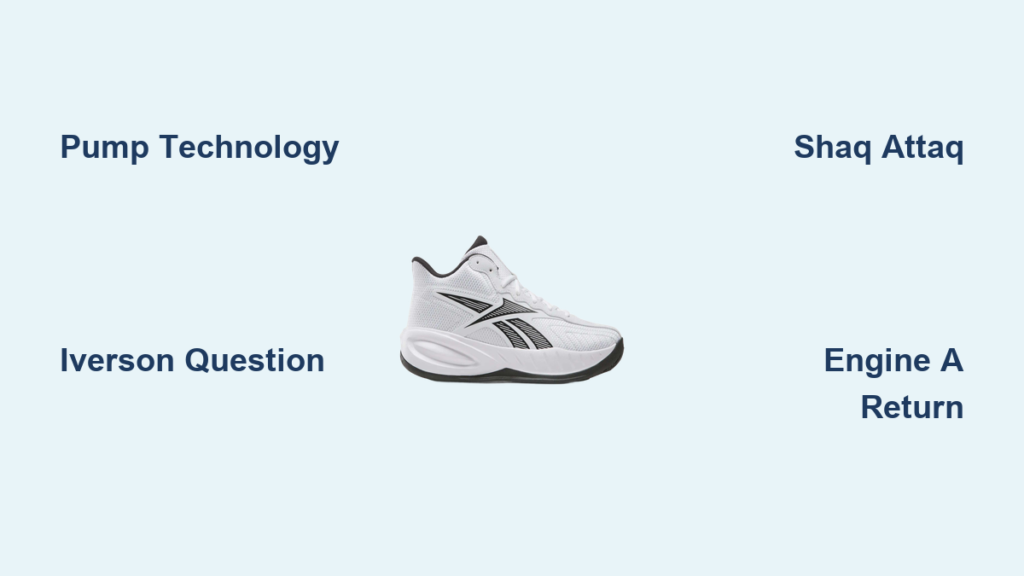
If you’ve ever seen Allen Iverson cross over defenders in sleek black-and-silver Reeboks or watched Dee Brown pump his shoes before a blindfolded dunk, you’ve witnessed a piece of basketball footwear history. Reebok basketball shoes represent more than athletic performance—they’re cultural artifacts that defined an era of sport, style, and self-expression. From the revolutionary Reebok Pump to Iverson’s iconic Question and the brand’s bold 2025 return with the Engine A, this is the complete story.
Once the top athletic shoe brand in the United States, Reebok dominated NBA courts in the 1990s before retreating from performance basketball in the 2010s. Now, under Authentic Brands Group ownership and led by legends Shaquille O’Neal and Allen Iverson, Reebok is making a full-court press back into the game. This comprehensive history covers every era, technology, and signature model that shaped Reebok basketball shoes.
British Origins: J.W. Foster and the Birth of a Sneaker Giant (1895–1979)
Reebok’s story begins not in America, but in Bolton, England, where 14-year-old Joseph William Foster designed spiked running shoes in his bedroom above his father’s sweetshop in 1895. By 1900, Foster formalized the business as J.W. Foster, later becoming J.W. Foster and Sons, operating from the “Olympic Works” factory. These leather running shoes with spikes, called “running pumps,” became the preferred choice for British Olympic athletes, most notably Harold Abrahams, who wore them to win gold in the 100 meters at the 1924 Paris Games.
In 1958, Foster’s grandsons Jeff and Joe Foster branched from the family business and launched Mercury Sports Footwear, soon renamed Reebok after the Afrikaans word for the grey rhebok antelope. From 1958 until 1986, the Reebok logo featured the Union Jack to signal British heritage. The company remained a small European player until an American businessman discovered the brand at a Chicago trade show.
Paul Fireman and U.S. Expansion (1979)
In 1979, Paul Fireman, then with Boston Camping, encountered Reebok at the NSGA Show in Chicago. He secured U.S. distribution rights and launched three premium models at $60 each, unusually high for the time. Despite the premium pricing, demand surged. By 1981, Reebok cleared $1.5 million in sales, establishing the American foothold that would transform the brand into a global powerhouse.
The Aerobics Boom and Fitness Empire (1982–1989)
In 1982, Reebok debuted the Freestyle, the first athletic shoe designed specifically for women, capitalizing on the burgeoning aerobics craze. The Freestyle became the number-one selling shoe in Reebok history, accounting for more than half of company sales by 1984. Reebok followed with the Princess, Empress, and Dutchess lines, cementing dominance in women’s fitness footwear.
In 1984, Reebok released the Workout, a leather training shoe featuring the iconic H-strap across the midfoot. This design offered lateral stability and became an instant classic, still reissued today in retro collections. The H-strap wasn’t just functional—it was a fashion statement bridging gym performance and street style.
By 1983, Reebok’s net sales reached approximately $12.8 million, and the company went public in 1985. By the mid-1980s, Reebok’s sales surged to approximately $1 billion, allowing it to overtake Nike as the largest athletic shoe manufacturer in the United States, a position it held until 1988.
Step Reebok and Cultural Impact (1989)
In 1989, Reebok partnered with fitness instructor Gin Miller to launch Step Reebok, a molded plastic platform for step aerobics. Backed by research from San Diego State University, the program exploded in popularity, peaking in 1995 with 11.4 million participants. Reebok capitalized with high-top training shoes designed for ankle support, turning fitness into a billion-dollar lifestyle category.
The Golden Era: Pump Technology, Shaq, and Iverson (1989–1999)
In 1989, Reebok introduced one of the most iconic technologies in sneaker history: the Reebok Pump. The concept originated when Paul Lichfield, a former biochemistry PhD candidate, was tasked with creating a performance basketball shoe inspired by medical air splints used in rehabilitation. The goal was a shoe with inflatable support that could custom-fit the foot in real-time.
Early prototypes like the Pro Pump featured side-mounted dials and heel-based activation systems but were deemed too bulky for mass production. The breakthrough came from Paul Brown, Reebok’s VP of Design, who created a sleek silhouette with a side-mounted pump mechanism and inflatable ankle collar. Released as a men’s basketball shoe, the Pump offered the first adjustable fit controlled with manual air allocation.
Dee Brown and the Pump Goes Viral (1991)
The Pump became legendary during the 1991 NBA Slam Dunk Contest when Celtics rookie Dee Brown paused mid-air, pumped his shoes, then dunked blindfolded. That moment wasn’t just athletic brilliance—it was marketing gold. The image of Brown tightening his Reeboks before the dunk became iconic, propelling the Pump into pop culture. Artists like Tupac and The Notorious B.I.G. wore them in music videos, turning performance gear into streetwear.
Shaq Signs and the Shaq Line (1992)
Reebok doubled down on basketball in 1992 by signing Shaquille O’Neal before his NBA debut. That same year, they released the Shaq Attaq, a bold, aggressive shoe built for power and presence. With its oversized Reebok logo and rugged construction, the Shaq Attaq reflected O’Neal’s dominant style. It was followed by classics like the Shaq II, Shaq III, and Shaqnosis—a fan-favorite that remains widely reissued today.
Allen Iverson and the Question (1996)
In 1996, Reebok signed Allen Iverson to a $50 million deal, one of the richest athlete endorsements of its time. Iverson wasn’t just a player—he was a cultural force. His debut shoe, the Reebok Question, dropped the same year. With its translucent outsole, gillie lacing, and clean black-white colorway, it drew comparisons to the Air Jordan 11 but carved its own identity. The Question wasn’t just a shoe—it was a symbol of defiance, speed, and individuality.
The Answer Line: Nearly Two Decades of Innovation
Reebok released a new Answer shoe nearly every year from 1997 to 2014, making it the second-longest signature line in basketball history after Jordan.
• Answer 1 (1997): Hidden lacing, DMX cushioning
• Answer 4 (2000): Worn during Iverson’s MVP and Finals run
• Answer 6 (2002): Returned with zipper shroud and “IVERSON” heel
• Answer 9 (2005): Debuted Pump 2.0 with on-off valve
• Answer 10 (2006): Celebrated the 10th model with ankle strap
• Answer 14 (2014): Final release, featuring DMX Foam and full-grain leather
Each model reflected Iverson’s evolving game and style—fast, fearless, and always ahead of the curve.
Adidas Era: Exit from Performance Basketball (2000–2021)
In 2005, Adidas bought Reebok for $3.8 billion, aiming to challenge Nike’s dominance. While Reebok kept its name, strategic shifts followed. By 2006, Adidas replaced Reebok as the NBA’s official uniform supplier, a symbolic blow to Reebok’s basketball presence.
Under Adidas, Reebok pivoted hard toward fitness. In 2010, Reebok partnered with CrossFit. In 2011, Reebok launched the Nano, the first CrossFit-specific shoe. In 2014, Reebok signed a six-year deal with the UFC. Basketball took a backseat, and by the early 2010s, Reebok had effectively exited the basketball performance market.
Logo Rollback and Heritage Revival (2019)
By 2019, fans missed the classic look. Reebok responded by restoring the 1992 Vector logo and original script font, signaling a return to its roots. The Delta logo remained on fitness lines, but the Vector became the face of Reebok’s heritage revival.
Reebok’s Basketball Comeback (2022–Present)
In March 2022, Authentic Brands Group acquired Reebok for $2.5 billion. ABG’s strategy was clear: return to sport. With annual retail sales reaching $5 billion by 2025, Reebok relaunched performance divisions in basketball, golf, tennis, football, and hockey.
Shaq and Iverson Lead the Return (2023)
In October 2023, Reebok named Shaquille O’Neal President and Allen Iverson Vice President of Reebok Basketball—a powerful signal of intent. This wasn’t just nostalgia. It was a strategic move to reignite the brand’s basketball legacy with its most iconic ambassadors at the helm.
Also in 2023, Reebok signed Angel Reese, the LSU national champion and social media sensation, in its first major NIL deal. Reese became a face of the brand’s new era—modern, bold, and rooted in women’s basketball.
Engine A: First Performance Hoops Shoe Since 2010s (2025)

On January 30, 2025, Reebok unveiled the Engine A, its first true performance basketball shoe in over a decade. Priced at $120, it launched globally on February 13, 2025, featuring an Energy Return System revived from 1987, an exoskeleton upper for lightweight breathability, herringbone traction optimized for cuts and crossovers, and design inspired by the 1990s Mobius line. The Engine A was built for today’s game—fast, responsive, and tech-forward.
Angel Reese 1: First WNBA Signature Shoe (2025)
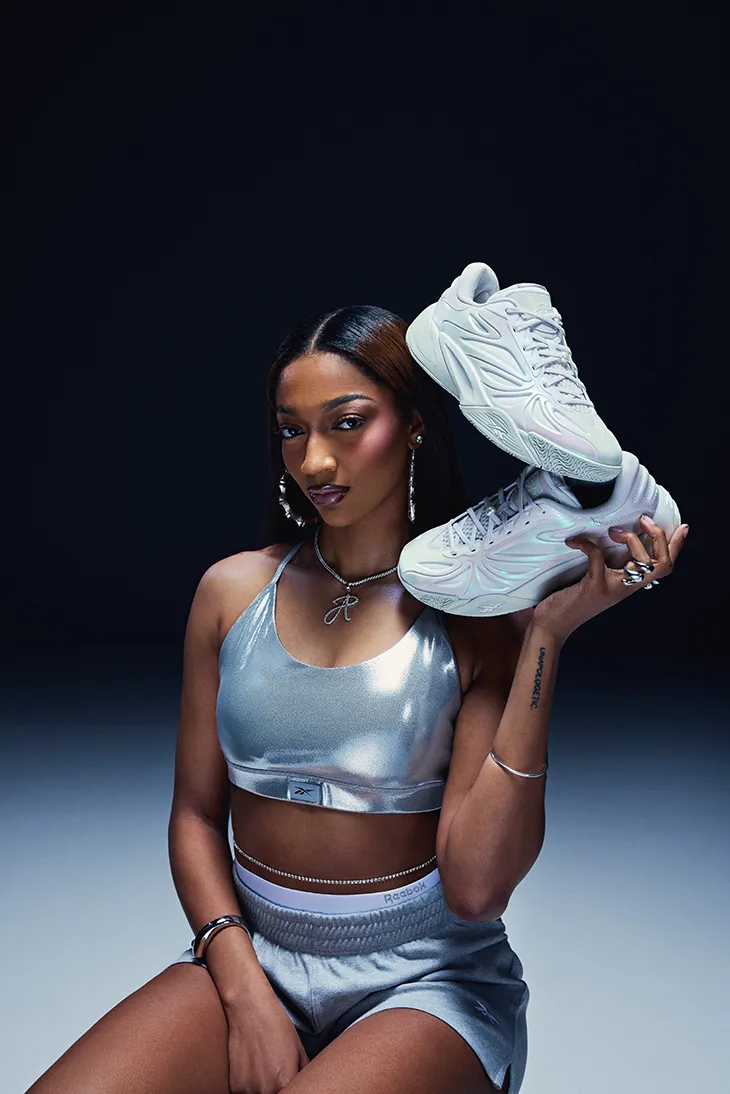
In September 2025, Reebok dropped the Angel Reese 1, its first signature basketball shoe for a WNBA athlete and first signature hoop shoe since 2012. Launched in three colorways—Diamond Dust, Mebounds, and Receipts Ready—it sold out on Reebok.com within hours of release. Designed with Reese’s input, the shoe blends performance and personal flair, marking a new chapter in women’s basketball footwear.
WNBA and NCAA Signings
Reebok expanded aggressively into basketball’s future. In December 2024, Reebok became an authorized footwear supplier of the WNBA. The brand signed WNBA players DiJonai Carrington and Lexie Brown. In May 2025, Reebok signed Darius Acuff Jr. to a signature shoe deal—the first NCAA men’s player from a major U.S. brand to receive one while still in college. This focus on youth and women signaled Reebok’s long-term vision: own the next generation.
Key Technologies Behind Reebok Basketball Shoes

Reebok has developed several breakthrough technologies throughout its basketball shoe history.
The Reebok Pump, introduced in 1989, uses a manual air bladder for custom ankle fit. It peaked in the Answer 9, Answer 10, and Pump Omni Zone II. The Pump became a cultural icon, featured in music, film, and streetwear.
DMX cushioning, introduced in the 1990s, uses air channels that shift from heel to toe during the gait cycle. It appeared in Answer 1 through 7, Q96, and Answer 14, with variants including DMX Lite and DMX I-pak.
Hexalite, introduced in the 1990s, uses honeycomb foam for shock absorption. It appeared in Question 3 and Answer 13.
The Energy Return System, originally introduced in 1987, uses spring-like cylinders in the midsole for responsive bounce. It was revived in the 2025 Engine A.
FloatZig, launched in 2024, features lightweight foam with carbon-fiber plate options, showing Reebok’s ongoing innovation beyond basketball.
Logo and Identity Timeline
Reebok’s visual identity has undergone significant transformations reflecting strategic shifts.
From 1958 to 1986, the logo featured the Union Jack, emphasizing British heritage. From 1986 to 2014, the Vector logo—an abstract Union Flag streak across a race track—signaled transition to a performance brand. From 2000 to 2005, the stylized “Rbk” logo targeted a younger street-culture demographic. From 2014 to 2019, the Delta logo represented physical, mental, and social change during the fitness-focused era. From 2019 to present, the restoration of the Vector and classic script acknowledges consumer preference for heritage identity.
Global Reach and Controversies
Reebok’s basketball sponsorships have expanded significantly. The brand became an authorized footwear supplier of the WNBA in 2024 and signed NBA players including Matas Buzelis. In tennis, Reebok signed Venus Williams in 1995 and, in 2026, Polish player Magdalena Fręch. In soccer, Reebok has sponsored Liverpool, Bolton Wanderers, and Manchester City, among others.
Several controversies have marked Reebok’s global operations. In 2025, Reebok signed a kit sponsorship with the Israeli national team, leading to a letter from 367 Palestinian sports teams urging a retraction. Following the 2022 Russia-Ukraine invasion, Reebok suspended Russian operations, transferring business to Turkish retailer FLO Retailing. In 2012, Reebok India faced a $233 million embezzlement scandal involving former executives.
Final Thoughts on Reebok Basketball Shoes History
Reebok’s journey from British track shoes to global basketball icon to fitness leader and back to the hardwood is a masterclass in brand evolution. Its history isn’t just about shoes—it’s about culture, courage, and comeback. The brand dominated the 1990s with revolutionary Pump technology and signature lines from Shaq and Iverson, retreated during the Adidas era, and now roars back with the Engine A and Angel Reese 1. Whether you’re a fan of the original Pump, the Question, or the new Angel Reese 1, one thing is clear: Reebok basketball shoes are back as contenders, not just relics.
Frequently Asked Questions About Reebok Basketball Shoes History
When was the Reebok Pump introduced?
The Reebok Pump was introduced in 1989 as a revolutionary basketball shoe featuring an inflatable bladder activated by a side-mounted pump. It was the first shoe offering custom fit through manual air allocation.
What was Allen Iverson’s first Reebok shoe?
Allen Iverson’s first Reebok shoe was the Question, released in 1996. It featured a translucent outsole, gillie lacing system, and clean black-white colorway, becoming one of the most iconic basketball shoes of all time.
How long was Reebok out of performance basketball?
Reebok effectively exited the performance basketball market in the early 2010s. The brand returned in 2025 with the Engine A, marking over a decade since its last performance basketball shoe.
Who currently leads Reebok Basketball?
In October 2023, Shaquille O’Neal was named President of Reebok Basketball and Allen Iverson was named Vice President. Both are former Reebok signature athletes whose deals helped define the brand’s golden era.
What is the Angel Reese 1?
The Angel Reese 1 is Reebok’s first signature basketball shoe for a WNBA athlete, released in September 2025. It launched in three colorways and sold out on Reebok.com within hours of its debut.
How much was Reebok acquired for in 2022?
Authentic Brands Group acquired Reebok for $2.5 billion in March 2022. The acquisition marked the beginning of Reebok’s return to performance sports, including basketball.