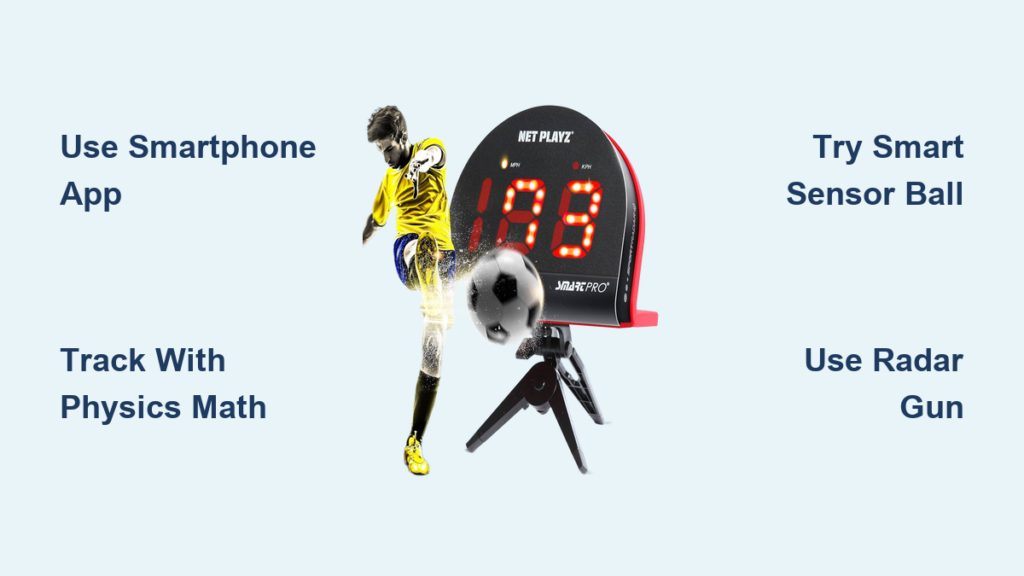
You’ve just struck a powerful shot, but do you actually know how fast the ball traveled? Whether you’re a player trying to boost your shot power, a coach evaluating team performance, or a parent helping your child improve their kicks, knowing how to measure soccer ball speed gives you concrete data to track progress. The good news is you don’t need professional equipment to get started. Several practical methods exist, ranging from free smartphone apps to physics calculations and sensor-equipped balls.
This guide covers every viable technique for measuring soccer ball speed, from quick DIY solutions to professional-grade tools. You’ll discover which methods offer the best accuracy for your budget, how to avoid common measurement mistakes, and which approach fits your specific needs as a player, coach, or educator.
Measure Kick Speed with Free Smartphone Apps
Smartphone apps provide the most accessible entry point for measuring soccer ball speed without spending any money. These tools work well for youth coaches, amateur players, and anyone wanting quick feedback during practice sessions.
Time Your Kicks with Speed Radar Gun App
The Speed Radar Gun for Football app for iOS lets you manually tap the screen when the ball is kicked and again when it reaches a target. The app then calculates your speed in miles per hour or kilometers per hour. It tracks your fastest kick, slowest kick, and average speed across multiple attempts. You can use it in real-time during kicks or load video footage later to analyze technique after practice.
Set your phone on a tripod or stable surface at field level before measuring. This minimizes camera movement and improves your timing accuracy significantly. The app also lets you customize kick distance settings, making it flexible for different field sizes.
Avoid Timing Errors That Skew Results
Human reaction delay is the biggest weakness in app-based timing. If you’re slow to tap the screen, your speed readings will be lower than actual. If you tap too early, you’ll get falsely high readings. A 0.2-second delay can make a 40 mph kick appear to travel at only 35 mph.
Practice your timing with slow rolls first to build consistency. Some users report getting an generic error message when kicks are extremely fast, likely because the app struggles with ultra-short time intervals. This makes the app less reliable for elite-level shots exceeding 70 mph.
Use the built-in charting feature to visualize improvement trends over time. This works especially well for motivating young athletes who can see their progress graphically.
Calculate Speed Using Physics and Basic Math

When technology isn’t available, physics equations turn any field into a measurement laboratory. This method uses distance traveled and flight time to compute true ball velocity, making it ideal for STEM education or budget-conscious training sessions.
Measure Kick Distance Exactly
Start with a known distance. Use yard lines on a regulation soccer field or place cones at 20 to 30 yards apart. Measure carefully because accuracy here directly impacts your final speed calculation. For example, 25 yards equals 22.7 meters when you divide yards by 1.1.
Record Flight Time Precisely
Use a digital stopwatch or record the kick with your phone’s slow-motion video mode at 60 frames per second or higher. Mark the exact frame when the ball leaves the kicker’s foot and when it hits the ground or reaches the target. Calculate the time difference between these two points. Higher video frame rates reduce timing error and provide more scientific accuracy.
Compute Horizontal Velocity
Horizontal motion isn’t affected by gravity, so horizontal velocity remains constant throughout the flight. Use the formula velocity equals distance divided by time. For 22.7 meters in 1.4 seconds, the horizontal velocity equals 16.7 meters per second.
Find Initial Vertical Velocity
Assume a symmetrical arc where time to reach peak height equals half of the total flight time. If total flight takes 1.4 seconds, time to peak equals 0.7 seconds. Using gravitational acceleration of 10 meters per second squared, the initial upward velocity equals 10 multiplied by 0.7, which gives 7 meters per second.
Combine Components for True Speed
Ball velocity is a vector combining horizontal and vertical speeds. Use the Pythagorean Theorem to find the resultant velocity. The calculation equals the square root of horizontal velocity squared plus vertical velocity squared. This equals the square root of 16.7 squared plus 7 squared, which equals approximately 17.6 meters per second.
Convert meters per second to miles per hour by multiplying by 2.237. This gives roughly 39.4 miles per hour, often rounded to 38 miles per hour.
This physics method assumes no air resistance and level takeoff and landing. Results may vary slightly for long kicks or high-altitude fields, but the method still provides excellent estimates for most training purposes.
Use Smart Sensor Balls for Real-Time Data
Smart balls with embedded sensors eliminate human error entirely and deliver instant feedback straight from the ball itself. These are the preferred tools for serious athletes and professional training environments.
Get Instant Readings with Speedball
The Speedball by Smith’s contains embedded sensors that measure exact speed at the moment of impact. The ball transmits data via Bluetooth to your smartphone in real-time. Every kick is recorded automatically, eliminating the need for manual timing or calculation. Players see immediate results like “Your last shot: 52 miles per hour” and “Personal best: 58 miles per hour.”
Train with Data-Driven Feedback
The instant feedback encourages competition and focused power development. Coaches use the data to compare player output, adjust training intensity, and monitor fatigue levels by tracking declining speed over repeated kicks. This transforms raw numbers into actionable insights for performance optimization.
Keep sensors performing accurately by charging the ball regularly, updating firmware through the companion app, and calibrating before major testing sessions. While expensive, smart balls pay off in youth academies and elite training environments where precision matters most.
Choose Radar Guns for Professional Accuracy

Radar guns remain the gold standard for measuring soccer ball speed in professional trials, television challenges, and sports performance laboratories. These devices emit radio waves that bounce off the moving ball and measure the frequency shift using the Doppler effect.
How Radar Technology Works
Radar guns capture instantaneous speed at launch with accuracy within plus or minus 1 mile per hour. They read peak velocity in milliseconds and remain completely unaffected by human reaction time. Common models include Stalker and Bushnell, frequently seen at MLS combines and UEFA testing events.
Compare Accuracy Across Methods
Radar guns offer the highest accuracy, followed by smart balls, then physics calculations, and finally smartphone apps. Choose based on your budget and required precision level. Radar guns cost between $150 and $500 but work across multiple sports including baseball and tennis, making them smart investments for multi-sport facilities.
Follow Best Practices for Reliable Measurements
Consistency matters more than fancy tools when measuring soccer ball speed. Standardized conditions ensure trustworthy results you can actually use to track progress.
Standardize Your Testing Conditions
Use the same ball inflated to regulation pressure between 8.5 and 15.6 psi. Kick from the same surface type whether grass, turf, or indoor flooring. Avoid windy days because wind alters both flight time and speed readings significantly.
Calibrate Tools Before Each Session
For apps, practice your timing and test against known speeds when possible. For video analysis, confirm your frame rate and use timestamps carefully. For smart balls, reset sensors between different users and update firmware regularly.
Take Multiple Measurements and Average Results
One kick never tells the whole story. Record 5 to 10 kicks and calculate both the maximum speed as your peak performance and the average speed to gauge overall power. Discard obvious outliers like mishits or very short taps that don’t represent normal technique.
Cross-Check Methods for Validation
Combine tools to verify your results. Time a kick with an app and calculate the physics manually to compare. Use smart ball readings alongside radar gun measurements. When multiple methods align closely, you know your data is solid.
Apply Speed Data to Improve Performance
Raw numbers become meaningful only when you use them effectively. Different users leverage ball speed measurements in distinct ways to achieve specific goals.
Players Should Track Progress and Set Goals
Set concrete targets like increasing your average shot speed from 40 to 50 miles per hour. Train with a smart ball weekly and log results to see improvement over time. Compare instep kicks versus laces kicks to find your most powerful technique.
Coaches Should Optimize Team Training
Identify your strongest shooters for set piece duty and free kicks. Design speed-focused drills like rapid-fire shooting circuits. Monitor workload by tracking whether speeds drop during later practice sessions, which may signal fatigue.
Educators Should Teach Physics Through Soccer
Students can measure time and distance, calculate velocity and maximum height, and learn about vectors, gravity, and motion through real-world application. This approach engages students who love sports while making physics concepts unforgettable.
Pick the Right Tool for Your Situation
| Tool | Cost | Accuracy | Best For |
|---|---|---|---|
| Smartphone App | Free to $1 | Medium | Youth coaching, casual use |
| Physics Calculation | $0 | Medium | Education, budget analysis |
| Smart Ball | $$$ | High | Academy training, serious athletes |
| Radar Gun | $$ to $$$ | Very High | Professional testing |
Start with the Speed Radar Gun for Football app if you’re a casual player. Invest in a Speedball or radar gun if you’re a serious athlete or coach. Use physics calculations with video analysis if you’re a teacher. Combine app timing with periodic radar validation if you’re coaching a team.
Frequently Asked Questions About Measuring Soccer Ball Speed
Can I measure soccer ball speed with my phone without any apps?
You can use your phone’s stopwatch and video recording to measure speed manually. Record the kick in slow motion, then play back the video to measure the exact time between ball contact and landing. Combine this with a measured distance to calculate speed using physics formulas.
What is a good soccer ball speed for a professional player?
Professional players typically achieve shot speeds between 60 and 80 miles per hour during free kicks and powerful shots. Elite players like Cristiano Ronaldo have been recorded exceeding 80 miles per hour. Youth players generally range between 30 and 50 miles per hour depending on age and development.
How accurate are smartphone apps for measuring soccer ball speed?
Smartphone apps offer moderate accuracy but suffer from human reaction delay. They’re reliable for tracking relative progress and comparing players at the same skill level. However, they lack precision for professional-grade measurement and may show errors for extremely fast kicks over 70 miles per hour.
What is the most accurate method for measuring soccer ball speed?
Radar guns offer the highest accuracy with readings within plus or minus 1 mile per hour. Smart sensor balls provide highly accurate real-time data but cost significantly more. Physics-based calculations are accurate when measurements are precise but depend on assumptions about air resistance and launch conditions.
Do I need special equipment to measure soccer ball speed?
You don’t need special equipment to get started. Your smartphone with a free app and a stopwatch provides enough to measure basic speed. For more accurate data, consider investing in a smart ball or radar gun depending on your budget and training goals.
Key Takeaways for Measuring Soccer Ball Speed
Start measuring your kicks today because the data transforms guessing into knowing. Your phone with a free app gives you immediate feedback without spending money, making it perfect for casual players and youth coaches. Physics calculations provide deeper insight into ball flight and work excellently for educational purposes or validating other tools.
Smart sensor balls like Speedball deliver the most accurate real-time data for serious athletes willing to invest in their training. Radar guns remain the gold standard for professional testing and are worth the investment for multi-sport facilities or dedicated coaches. Always standardize your testing conditions and take multiple measurements to ensure reliable results.
The most important step is simply beginning. Set up your phone, choose your method, and start tracking. Every number tells you something about your power, technique, and progress. Whether you’re chasing personal records or coaching the next generation of players, understanding how to measure soccer ball speed turns every strike into data that drives improvement.