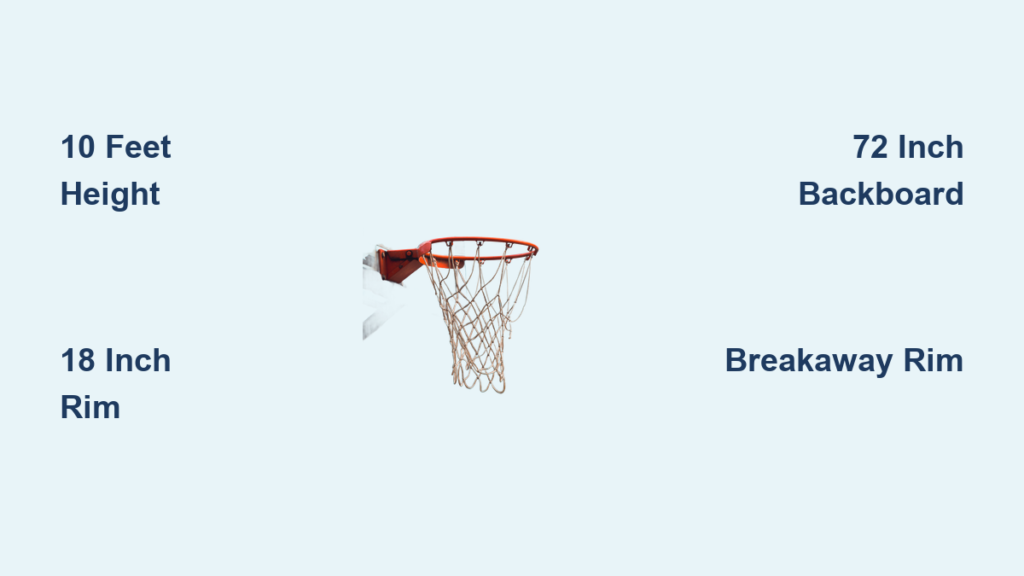
If you’re setting up a home court, coaching youth basketball, or just curious about the exact specs behind the game, knowing basketball hoop dimensions is essential. From the rim height to backboard size and net length, every measurement plays a role in gameplay, safety, and realism. Whether you’re aiming for NBA-level accuracy or choosing the right portable hoop for your driveway, understanding these standards ensures you get the most authentic experience possible.
The good news is that the core dimensions are consistent across all levels of play. The standard rim height is 10 feet (3.05 meters), and the rim’s inner diameter is always 18 inches (45.7 cm). These specs have remained unchanged since Dr. James Naismith invented basketball in 1891, when he nailed peach baskets to a railing exactly 10 feet off the ground. This guide breaks down every critical dimension, including backboard sizes, rim placement, net specs, and setup tips for residential systems.
Regulation Rim Height: 10 Feet Standard
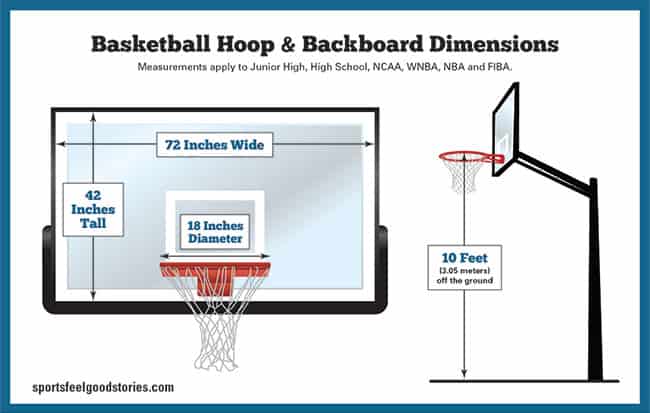
The most fundamental dimension in basketball is the rim height, measured at 10 feet (3.05 meters) from the playing surface to the top edge of the rim. This rule applies universally across professional, collegiate, and scholastic play.
Why 10 Feet?
Dr. James Naismith chose 10 feet purely by circumstance. The railing in the Springfield College gym where he invented the game was that high, and the height stuck because it strikes the perfect balance between accessibility and athleticism. It’s high enough to challenge jump shots and dunks but low enough to allow skill development and consistent shooting mechanics.
Measuring Correctly
Always measure to the top inside edge of the rim, not the bottom. Use a tape measure on a flat, paved area to avoid inaccurate readings. Check regularly because outdoor portable hoops can settle or shift over time, especially on uneven driveways.
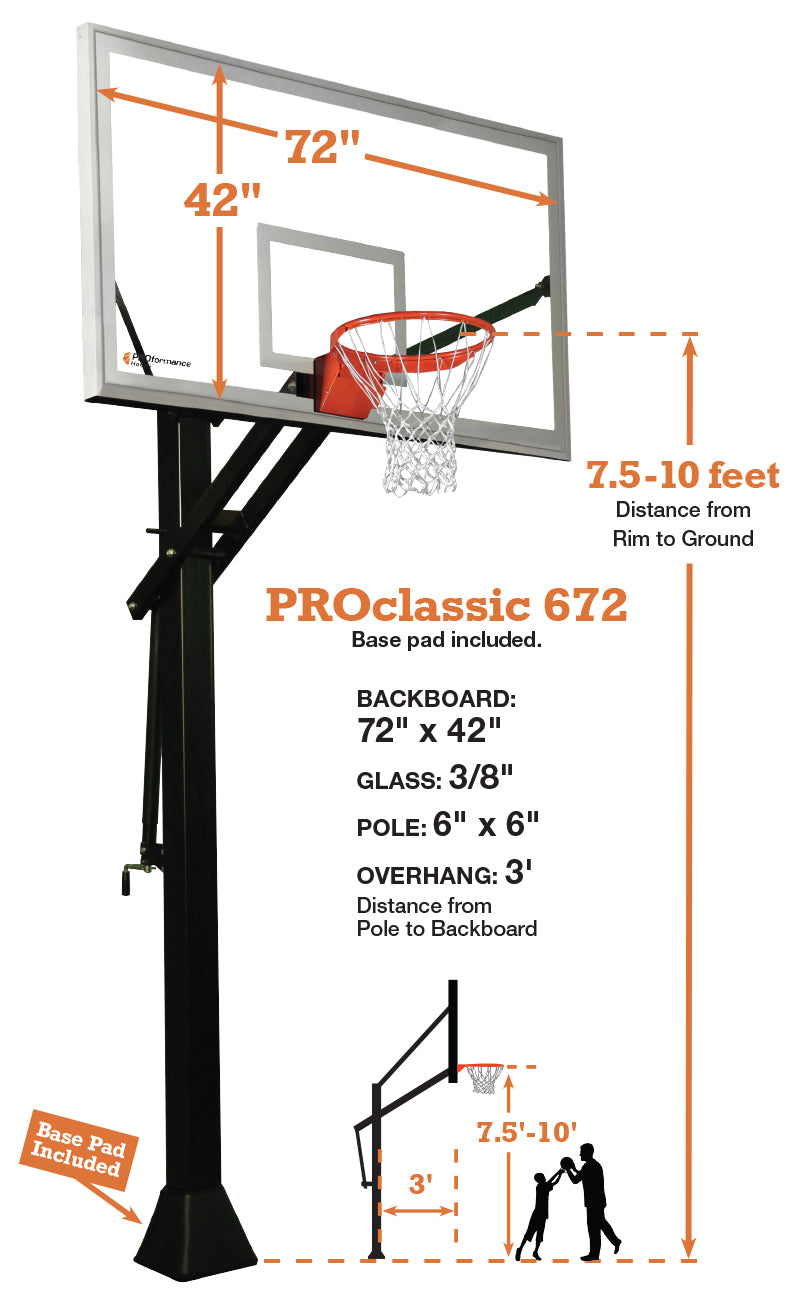
Pro Tip: For youth players ages 5 to 12, lowering the rim to 8 or 9 feet helps develop proper form without frustration. Most adjustable systems allow settings from 7.5 to 10 feet in 1-inch increments.
Rim Diameter and Construction Specs

The rim must be large enough for a basketball to pass through cleanly while providing consistent bounce and durability during dunks and rebounds.
18-Inch Inner Diameter Standard
The inside diameter is exactly 18 inches (45.7 cm), identical across NBA, FIBA, NCAA, and high school. The rim is made from high-tensile carbon steel, typically 1.375 inches (3.5 cm) thick, with a bright orange finish for visibility against backboards and nets. This size accommodates a Size 7 men’s basketball (29.5-inch circumference) with just enough clearance for smooth passage and predictable rim action.
Breakaway vs. Static Rims
Breakaway rims are spring-loaded to flex under pressure (like dunks) and snap back. They are required in professional and high-end residential systems. Enclosed springs are found on premium models and protect against rust and weather. Exposed springs are common on budget hoops and are prone to corrosion over time. Static rims do not flex and are best for light play or decorative use only.
Warning: Never attempt to dunk on a static or non-breakaway rim. The risk of injury or equipment damage is high.
Backboard Dimensions: Size, Shape & Materials

The backboard affects shooting accuracy, rebound realism, and overall court aesthetics. While professional courts use one standard size, home systems offer several options.
Regulation Backboard: 72″ x 42″
The official width is 72 inches (6 feet or 183 cm), and the height is 42 inches (3.5 feet or 107 cm). The thickness is 1 inch (2.54 cm) for glass and acrylic models. This full-size board is used in NBA, NCAA, and FIBA competitions, providing maximum surface area for bank shots and consistent rebound angles.
Common Residential Sizes
Full-size 72-inch boards are ideal for serious players and two-car driveways. Sixty-inch boards work well in mid-sized spaces and offer balanced performance. Fifty-four-inch boards fit compact areas and are suitable for youth play. Forty-four-inch boards are best for small spaces and young children.
Tip: A 60-inch backboard offers the best compromise between space savings and realistic rebounding.
Backboard Shapes
Rectangular is the standard shape for regulation play and maximizes bank shot surface. Fan-shaped is an aesthetic alternative with reduced play area and is not recommended for serious training.
Backboard Materials Compared

The material impacts bounce, clarity, durability, and price. Choosing the right one depends on your budget and how authentic you want the feel to be.
Tempered Glass
Tempered glass provides the best realism with true gym-like rebound and spin. It is used in NBA arenas and high-end home systems. The visibility is clear and unobstructed for viewing rebounds. The downside is that tempered glass is heavy and requires strong support, though it is designed to resist shattering.
Acrylic
Acrylic is a mid-range option that looks like glass but is lighter and less expensive. The rebound is slightly softer than glass and may yellow over time over years of outdoor exposure. It is ideal for residential use with moderate play.
Polycarbonate
Polycarbonate is budget-friendly, impact-resistant, and weatherproof. The feel is similar to acrylic, and it is often used in outdoor portable hoops. The drawback is that it can warp under prolonged sun exposure.
Metal
Metal is rare and not recommended. It has poor rebound quality and is prone to dents. You might find it in low-cost or temporary setups.
Expert Note: If you want the authentic feel of a gymnasium, invest in a 72-inch tempered glass backboard with a square steel pole.
Target Rectangle (Shooter’s Square)
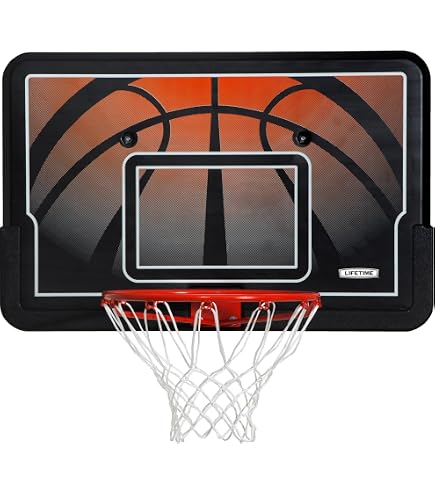
Painted on the front of the backboard, this visual aid helps players aim bank shots.
Dimensions and Position
The rectangle is 24 inches wide by 18 inches high (61 cm by 45.7 cm), with 2-inch-wide lines. It is centered behind the rim, aligned vertically and horizontally. The rectangle forms a guide for hitting the correct spot on the glass for layups and jump shots. While not used in professional games for aiming, it is invaluable for youth and skill development.
Rim-to-Backboard Distance: 6 Inches
The rim must extend precisely from the face of the backboard to ensure regulation play.
Key Measurements
The inside rim to backboard face distance is exactly 6 inches (15.24 cm). There is about a 2-inch (5.08 cm) gap between the backboard and the mounting bracket. The rim must be level and centered on the backboard.
This offset allows space for the ball to pass through cleanly and prevents interference during layups.
Visual Cue: When viewed from the front, the rim should appear centered with equal space on both sides of the backboard.
Overhang: Pole Clearance & Safety

Overhang is the horizontal distance from the backboard face to the support pole. It directly impacts safety and playability.
Recommended Overhang Ranges
Professional systems range from 47 to 63 inches (120 to 160 cm). High-end home systems range from 31 to 47 inches (80 to 120 cm). Entry-level systems range from 24 to 31 inches (60 to 80 cm).
Why Overhang Matters
Safety is the primary concern. Greater overhang prevents players from colliding with the pole during drives or rebounds. It also improves playability by allowing space for layups, dunks, and baseline moves. However, greater overhang requires stronger poles and secure anchoring.
Minimum Recommendation: Choose a system with at least 31 inches (80 cm) of overhang for serious play.
Net Specifications: Length & Material
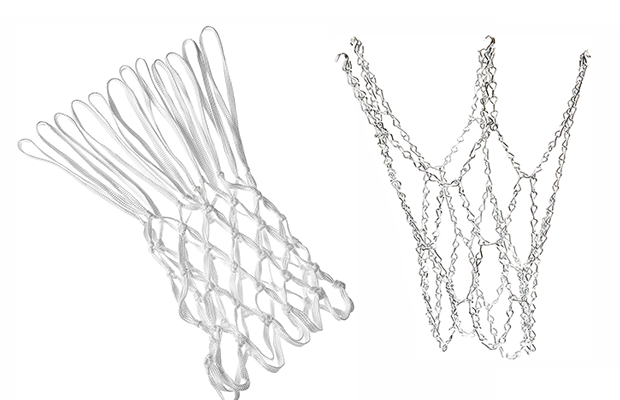
The net confirms a made basket and adds rhythm to the game.
Regulation Net Details
The length is 15 to 18 inches (38 to 46 cm). The material is white nylon cord with a thread count between 30 and 120 threads. The function is to “check” the ball momentarily as it passes through.
Net Alternatives
Chain-link nets are durable and long-lasting but are noisy and prone to rust. Breakaway clips allow the net to detach under extreme pressure (like dunking), protecting the rim.
Maintenance Tip: Replace nylon nets every 1 to 2 years if used outdoors. Inspect chain nets for rust regularly.
Court Placement: Key Distances

For full-court setups, proper spacing ensures regulation compliance.
Essential Measurements
The free throw line is 15 feet from the backboard face. The three-point line is 23 feet 9 inches from the center of the rim in NBA play. The restricted area arc is 4 feet radius from the center of the rim. The baseline to backboard distance is 4 feet in professional settings.
These distances help create a realistic playing environment, especially for training and scrimmages.
Portable Hoop Setup: Base & Stability

Portable systems offer flexibility but require proper weighting to stay safe and functional.
Base Weight Requirements
The typical range is 200 to 400 lbs (90 to 180 kg). Filling options include water (easy but lighter and can freeze), sand (heavier and more stable but harder to handle), and BaseGel (a specialized compound that hardens with minimal water, equivalent to 400 lbs of sand with only 16 oz of water).
Base Dimensions
Typical width is 4 to 5 feet and depth is 2 to 3 feet. Stability features include anchor kits, locking height mechanisms, and non-slip pads.
Pro Tip: Fill the base with sand or BaseGel if you plan to dunk or live in a windy area.
Pole Types: Round vs. Square

The pole supports the entire system and affects stability and performance.
Round Poles
Round poles are common in portable and entry-level in-ground systems. They are made of multi-piece steel tubing but can wobble or vibrate during aggressive play.
Square Poles
Square poles are used in high-end residential and competition systems. They are made of single-piece square steel and offer superior rigidity with minimal shake. They also support larger backboards and dunking.
Verdict: For serious play, square poles are the clear winner.
Height Adjustment: For Kids & Growing Players

Adjustable hoops are ideal for families and youth development.
Standard Adjustment Range
The lowest setting is 7.5 feet (some go down to 7 feet). The highest setting is 10 feet. High-quality models adjust in 1-inch steps.
Recommended Heights by Age
For ages 5 to 7, the ideal rim height is 6 to 8 feet. For ages 8 to 10, it is 8 to 9 feet. For ages 11 to 12, it is 9 to 10 feet. For ages 13 and up, it is 10 feet.
Tool-free mechanisms (crank, lever, or hydraulic lift) are highly rated for convenience.
Installation & Safety Tips
Proper setup prevents accidents and extends equipment life.
Installation Checklist
The surface must be flat, level, and paved (like a driveway or concrete pad). Allow at least 5 feet behind and 3 feet on each side for clearance. Avoid trees, fences, power lines, and sidewalks. In-ground hoops require concrete. Portable bases must be fully filled.
Safety Features to Look For
Look for rounded edges on the frame and base. Non-slip base coating is essential. A breakaway rim with enclosed springs is recommended. Wind stakes or anchor kits are important for portable units.
Warning: Never install a hoop on public sidewalks. Most municipalities prohibit it due to liability concerns.
Maintenance: Longevity & Performance
Regular care keeps your hoop safe and functional.
Monthly Inspection Points
Check for loose bolts or welds. Inspect rim alignment and levelness. Look for rust, cracks, or warping. Ensure the net is intact and properly attached.
Weather Protection
Cover the backboard during winter or heavy rain. Drain water-filled bases in freezing climates. Lubricate adjustment mechanisms annually.
Pro Tip: Inspect enclosed spring rims less frequently than exposed spring models, as they are better protected from the elements.
Frequently Asked Questions About Basketball Hoop Dimensions
What is the official height of a basketball hoop?
The official regulation height is 10 feet (3.05 meters) from the playing surface to the top edge of the rim. This standard applies to all competitive levels, including NBA, NCAA, and high school games.
What is the diameter of a regulation basketball rim?
The inside diameter of a regulation rim is 18 inches (45.7 cm). This measurement is consistent across all levels of play worldwide.
What are the dimensions of a regulation backboard?
A regulation backboard measures 72 inches wide by 42 inches high (6 feet by 3.5 feet). The standard thickness is 1 inch for glass and acrylic models.
How far should the rim be from the backboard?
The rim must be exactly 6 inches (15.24 cm) from the face of the backboard. This horizontal offset allows the ball to pass through cleanly during shots and layups.
What size basketball hoop should I buy for my driveway?
For most residential driveways, a 60-inch acrylic backboard offers the best balance of space savings and realistic rebounding. Choose a model with at least 31 inches of overhang and a sand or gel-filled base for stability.
Can I lower the rim for kids?
Yes. Most adjustable hoops range from 7.5 to 10 feet. For children ages 5 to 12, lowering the rim to 8 or 9 feet helps develop proper shooting form and confidence before transitioning to the full 10-foot height.
Key Takeaways for Basketball Hoop Dimensions
Understanding basketball hoop dimensions ensures you get the most authentic playing experience possible. The two non-negotiable specs are the 10-foot rim height and 18-inch rim diameter, which have remained unchanged since the game’s invention in 1891. Everything else, including backboard size, material, and adjustability, should match your space, skill level, and budget.
For serious players, invest in a 72-inch tempered glass backboard with a square pole and breakaway rim. For families, a 60-inch acrylic backboard with adjustable height and proper overhang provides the best value. Regular maintenance, including checking rim levelness and inspecting for rust, extends the life of your system and keeps players safe.
With the right dimensions and setup, your backyard hoop can deliver the same feel as an NBA arena, right down to the last swish.