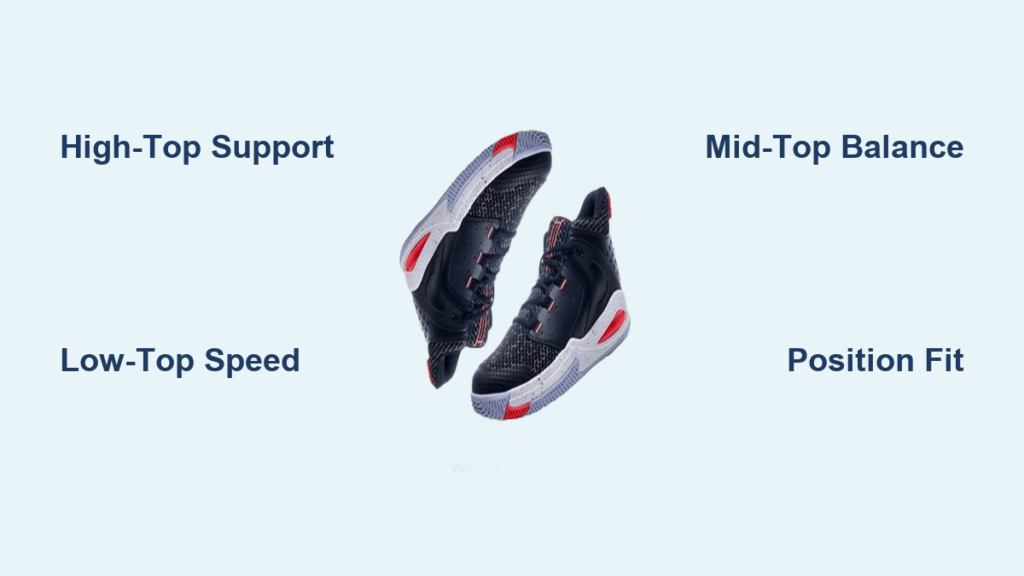
If you have ever stepped onto a basketball court, you know the right shoes can make or break your game. From explosive cuts to sudden stops and high-flying jumps, basketball demands footwear engineered for performance, protection, and precision. But with so many types of basketball shoes on the market, ranging from high-tops to low-tops and guard-specific builds to center-focused cushioning, it is easy to get overwhelmed. This guide breaks down every major category, helping you match your game to the perfect shoe.
High-Top vs. Mid-Top vs. Low-Top: What is the Difference?

The most visible way to categorize basketball shoe types is by collar height, but each style serves a distinct performance role.
High-Top Basketball Shoes
High-tops rise above the ankle, offering maximum heel lockdown and a secure, locked-in feel. While they do not inherently prevent ankle injuries, they provide psychological confidence and structural rigidity.
Best for:
• Players with a history of ankle rolls
• Centers and power forwards needing torsional stability
• Heavy or strong athletes requiring maximum support
Top Picks:
• Nike LeBron 23: ZoomX foam with stiff heel counter
• Anta KT 10: Stable bounce, synthetic build
• New Balance TWO WXY V5: 5/5 torsional rigidity, elite ankle containment
Mid-Top Basketball Shoes
Mid-tops sit at or just below the ankle, balancing mobility and support. They are the go-to for versatile players who need agility without sacrificing stability.
Best for:
• Wings and combo forwards
• Positionless players who cut, drive, and defend
• Those seeking a middle ground in weight and lockdown
Top Picks:
• Nike Jordan Luka 77: IsoPlate for stability, Zoom Air responsiveness
• Adidas Dame Line: Engineered for Damian Lillard’s sharp crossovers
• 361° ZEN 7: Full-length cushioning, worn by Aaron Gordon
Low-Top Basketball Shoes
Low-tops prioritize speed, agility, and court feel. They sit below the ankle, relying on wide bases, secure lacing, and stiff heel counters to prevent rolls.
Best for:
• Guards and quick perimeter players
• Shifty ball-handlers and fast-break finishers
• Anyone valuing lightweight movement and ground connection
Top Picks:
• Anta Kai 3: Kyrie Irving’s favorite with rounded outsole for pivoting
• Nike Sabrina 3: Only 12.4 oz, minimal stack height for true court feel
• Under Armour Curry 7: Decoupled Flow outsole for seamless transitions
Pro Tip: Low-tops do not increase injury risk if they fit well. The Anta Kai 3 and Curry 7 use wide forefeet and heel counters to prove support is not about height.
Best Basketball Shoes by Position
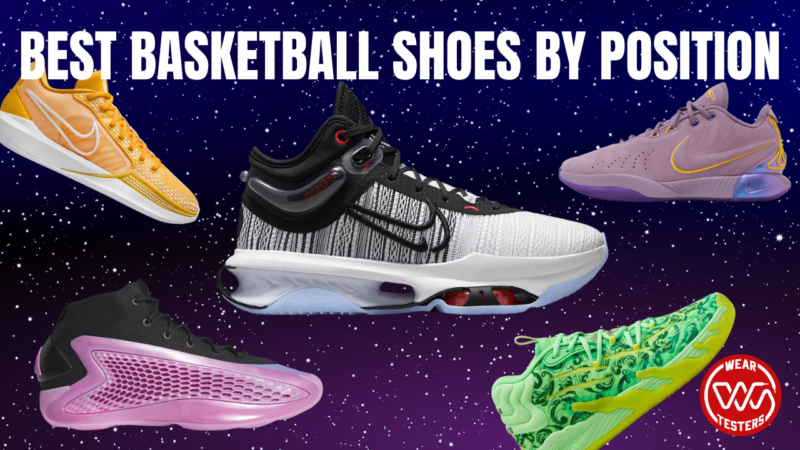
Your position dictates your shoe’s ideal traits, whether it is explosive traction for guards or max cushioning for centers.
Guards: Lightweight, Responsive, Agile
Guards need shoes that keep up with quick cuts, crossovers, and rapid direction changes.
What to Look For:
• Weight under 13 oz
• High energy return, preferably above 60%
• Multi-directional traction patterns
• Low-to-the-ground feel
Top Models:
• Nike G.T. Cut 3 Turbo: 83.2% energy return with ZoomX and carbon plate
• Anta Kai 3: Rounded outsole ideal for shifty guards
• Under Armour Curry 7: Flow outsole integrates midsole and outsole
• 361° BIG3 Series: ENRG-X+ foam built for speed and agility
Forwards: Balanced Cushion, Durable Traction
Forwards need a hybrid shoe, responsive enough for drives, stable enough for defense, and durable for all surfaces.
What to Look For:
• Moderate shock absorption between 90 and 110 SA
• Wide base for lateral stability
• Durable rubber compounds like XDR or Diamond Grip
• Mid-top or supportive low-top construction
Top Models:
• Nike KD 18: 116mm wide forefoot acts as an outrigger with 0.89 friction coefficient
• Jordan Luka Series: IsoPlate for step-back stability
• 361° ZEN 7 and AG 6: Diamond Grip rubber with propulsion technology
• Way of Wade 12: Super BOOM foam, 1:1 fit, outdoor-ready
Centers: Max Cushion, Heavy-Duty Support
Centers demand maximum impact protection, torsional rigidity, and heel lockdown to survive the paint.
What to Look For:
• Shock absorption above 110 SA in heel and forefoot
• High torsional rigidity, ideally 4 or 5 out of 5
• Heel counter stiffness rated 5 out of 5
• Durable outsole with high-top or robust mid-top
Top Models:
• Nike G.T. Hustle 3: 117 SA heel, 120 SA forefoot, best shock absorption on record
• Nike LeBron 23: 112 SA heel with ZoomX cushioning and carbon plate
• 361° Joker Series: Dual midsole with carbon plate and TPU stability
• New Balance TWO WXY V5: 5/5 torsional rigidity, elite heel lock
Cushioning Technologies Compared

The foam inside your shoe determines how it feels on impact, whether soft, bouncy, or responsive.
Supercritical Foams (Elite Energy Return):
• ZoomX (Nike): 70%+ energy return, found in LeBron 23 and G.T. Cut 3 Turbo
• Super BOOM (Li-Ning): Explosive responsiveness in Way of Wade 12
• Flow (Under Armour): Rubberless integrated midsole in Curry 7
• ENRG-X+ (361°): High rebound used in BIG3 and Joker lines
Air Units (Direct Impact Protection):
• Zoom Air Strobel: Full-length, direct-to-foot feel in KD 18 and Kobe 3 Protro
• Zoom Air Pods: Forefoot or heel units in Luka 77 and LeBron 23
Specialized Cushioning:
• C-Flow (361°): Soft yet responsive, reduces knee strain
• Dreamstrike (Adidas): Balanced cushion replacing Boost in takedown models
• FuelCell (New Balance): Fast, energetic ride in TWO WXY V5
Pro Tip: If you play outdoors, avoid overly soft foams because they compress faster on rough surfaces.
Traction That Wins Games
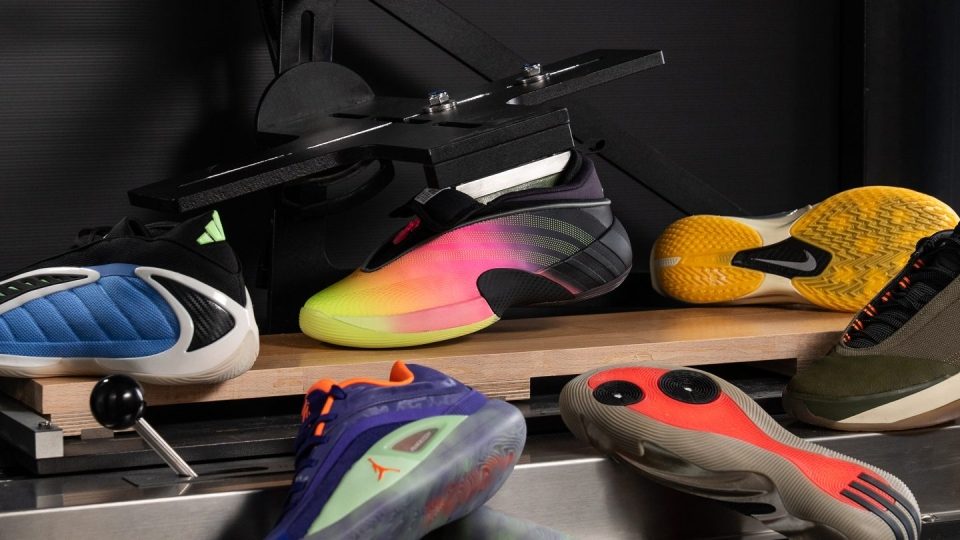
No feature matters more than traction. Slip once, and the game moves on without you.
Rubber Compounds:
• Solid Rubber: Durable, consistent grip, ideal for outdoor courts
• Translucent Rubber: Softer, better indoor grip, wears fast outside
• XDR (Nike): Extra Durable Rubber, outdoor-ready
• Diamond Grip (361°): Sharp bite used in Joker and AG lines
Traction Patterns:
• Herringbone: Classic multi-directional grip in AE 2 and Joker 2
• Radial/Circular: Pivoting-focused in Kyrie and Anta Kai lines
• Deep Tread: Prevents clogging on dusty or wet courts
Elite Traction: Nike KD 18 scores 0.89 friction, among the highest tested.
Support: Stability Beyond the Collar

True support comes from structure, not just height.
Torsional Rigidity:
Resistance to twisting is critical for cutting and landing.
• 5/5 Rigidity: New Balance TWO WXY V5, Giannis Immortality 4
• 4/5 Rigidity: LeBron 23, Joker 2 GT
Look for a stiff midfoot shank or carbon or TPU plate.
Heel Counter and Lockdown:
A stiff heel cup prevents slippage and stabilizes the ankle.
• Best Lockdown: TWO WXY V5, LeBron 23, Joker 2 GT
• Avoid if Wide-Footed: Sabrina 3, KD 18, Li-Ning Gamma 2
Outriggers and Plates:
• Outrigger: Extended lateral sole like KD 18’s 116mm base prevents rollovers
• Carbon Plate: Adds propulsion and stiffness in G.T. Cut 3 Turbo and Gamma 2
• IsoPlate (Jordan): Stabilizes during step-backs and crossovers
Best Brands and Signature Lines
Each brand offers unique tech and player-focused designs.
Nike and Jordan Brand:
• Flagship Tech: Zoom Air, ZoomX, React
• Top Shoes: LeBron 23, KD 18, G.T. Cut 3 Turbo
• Price Range: $68 (Immortality) to $225+ (LeBron)
Best Value: Giannis Immortality 4 at $90 offers wide base and 5/5 torsional rigidity.
Adidas:
• Flagship Tech: Lightstrike Pro, Dreamstrike, Lightboost
• Top Shoes: AE 2, DON Issue 7, Believe That 1
• Price Range: $100 to $160
Best Budget Outdoor Shoe: Believe That 1 under $130 with durable rubber.
Li-Ning and Way of Wade:
• Flagship Tech: Super BOOM, Carbon Fiber plates
• Top Shoes: Way of Wade 12, Gamma 2
• Price Range: $149 to $400+
Best for Explosiveness: Gamma 2 with ultra-light build and carbon plate.
Anta:
• Flagship Tech: A-Flashfoam, Nitrogen infusion
• Top Shoes: KT 10, Kai 3
• Price Range: $130 to $135
Best for Guards: Kai 3 with rounded outsole for pivoting.
361°:
• Flagship Tech: Qu!kCQTECH, Diamond Grip, ENRG-X
• Top Shoes: Joker 2 GT, ZEN 7, BIG3 6.0
• Price Range: €88 to €200
Best All-Around: Joker 2 GT with dual midsole and carbon plate.
Under Armour:
• Flagship Tech: Flow, Charged
• Top Shoe: Curry 7 at $160
Best for Fluid Movement: Curry 7 with decoupled outsole.
New Balance:
• Flagship Tech: FuelCell, Fresh Foam
• Top Shoe: TWO WXY V5
Best for Wide Feet: TWO WXY V5 with 2E widths available.
Indoor vs. Outdoor: Choose the Right Shoe
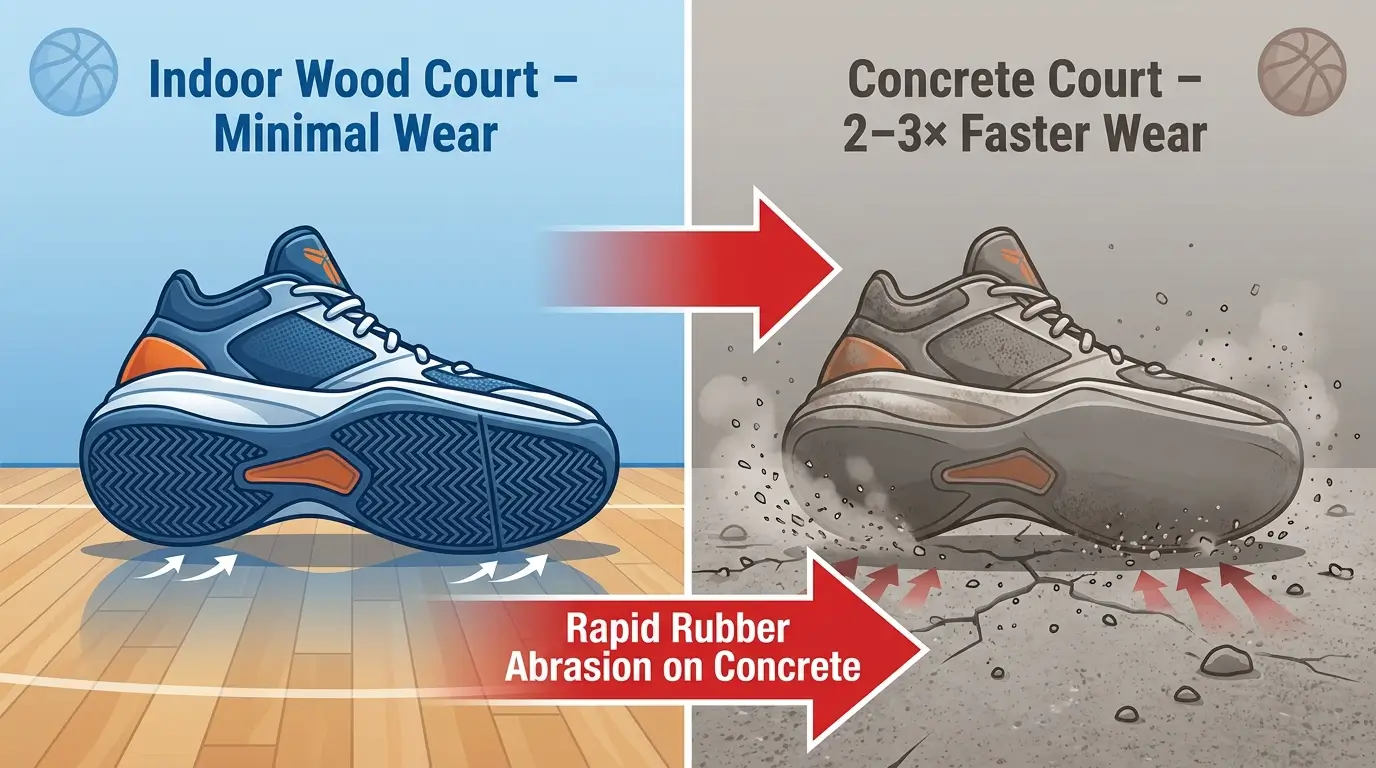
Playing surface determines durability and traction needs.
Indoor Courts (Hardwood):
• Best Shoes: G.T. Cut 3 Turbo, Curry 7, Sabrina 3
• Features: Soft rubber, intricate patterns, lightweight
Rotate indoor shoes to extend life because foam degrades faster under constant impact.
Outdoor Courts (Blacktop):
• Best Shoes: Believe That 1, Luka 77, All City 14, BIG3 Series
• Features: Hard rubber (XDR, Diamond Grip), deep treads, durable uppers
• Avoid: Translucent rubber and thin outsoles
Top Outdoor Pick: Adidas Believe That 1, built tough, under $130, great grip.
Fit, Sizing and Break-In Tips
Even the best shoe fails if it does not fit.
Sizing Guide:
• General Rule: Thumb’s width at toe, no heel slippage
• New Balance: Offers 2E widths, ideal for wide feet
• Adidas: Often runs snug, size up if between sizes
• Avoid if Wide-Footed: Sabrina 3, KD 18, Gamma 2
Break-In Process:
1. Walk Around: Soften synthetic uppers over 2 to 3 days
2. Practice Session: Test on court before game day
3. Tough Cases: Kobe 3 Protro needs 5 to 7 days, improves dramatically
4. Warning: Never debut a stiff shoe in a competitive game
Debunking Common Myths
Myth: High-tops prevent ankle sprains.
Truth: Stability comes from fit, base width, and heel counter, not collar height. Low-tops like Kai 3 are equally stable when properly designed.
Myth: Heavier shoes slow you down.
Truth: Weight differences like 12.4 oz versus 15.5 oz have minimal real-world impact. Comfort and confidence matter more.
Myth: Expensive means better performance.
Truth: Budget models like Giannis Immortality 4 and Believe That 1 outperform flagships in stability and durability for their price.
Frequently Asked Questions About Types of Basketball Shoes
What are the main types of basketball shoes?
The main types are categorized by collar height: high-tops rise above the ankle for maximum support, mid-tops sit at ankle level for balanced mobility, and low-tops sit below the ankle for speed and court feel. Each type serves different player needs and positions.
Which type of basketball shoe is best for guards?
Guards should look for lightweight low-tops under 13 oz with high energy return above 60%, multi-directional traction, and responsive cushioning like Zoom Air or Flow. Top choices include Nike G.T. Cut 3 Turbo, Anta Kai 3, and Under Armour Curry 7.
Do high-top basketball shoes actually prevent ankle injuries?
Not necessarily. Research shows ankle stability comes from muscular strength, ligament integrity, and shoe geometry like base width and torsional rigidity, not collar height. Low-tops can be equally supportive if designed with wide bases and stiff heel counters.
What is the best basketball shoe for outdoor courts?
The best outdoor basketball shoes feature durable rubber compounds like XDR or Diamond Grip, deep tread patterns, and synthetic uppers. Top picks include Adidas Believe That 1, Jordan Luka 77, and 361° BIG3 Series, all priced under $150 and built to handle rough surfaces.
How do I choose basketball shoes by position?
Guards need lightweight, responsive shoes with excellent traction. Forwards need balanced cushioning and durable traction. Centers need maximum shock absorption above 110 SA, high torsional rigidity, and secure heel lockdown. Match the shoe specs to your position demands.
Are expensive basketball shoes worth it?
Not always. Mid-tier models like Giannis Immortality 4 at $90 and Adidas Believe That 1 at $100 often match or exceed flagship performance in stability and durability for specific needs. Signature models carry a premium for brand and player affiliation.
Key Takeaways for Finding Your Perfect Basketball Shoe
The best types of basketball shoes are defined not by hype or price but by fit, function, and your specific game. Whether you need the plush protection of the G.T. Hustle 3 for joint preservation or the lightning responsiveness of the G.T. Cut 3 Turbo for explosive first steps, there is a shoe engineered for your style. Match your position, your typical playing surface, and your foot shape to the right technical specs, and you will step onto the court with confidence every single time.