Ever watched a free kick fly so fast it seemed to blur time, leaving goalkeepers frozen and crowds gasping? That raw power represents one of football’s most impressive athletic feats. The answer ranges from routine passes at 60 km/h to contested claims exceeding 210 km/h, with the only officially verified record sitting at 129 km/h. This guide breaks down verified records, measurement methods, player-specific data, and the biomechanics behind those legendary rocket shots.
You’ll discover the only scientifically validated world record, separate fact from myth in famous speed claims, and understand how technique, technology, and physics combine to launch a ball faster than a cheetah can sprint. Whether you are a player looking to add power to your shot, a coach analyzing performance metrics, or a fan curious about those viral “rocket shots” on TV, this article delivers everything you need to know about soccer ball speed.
Official World Record: 129 km/h
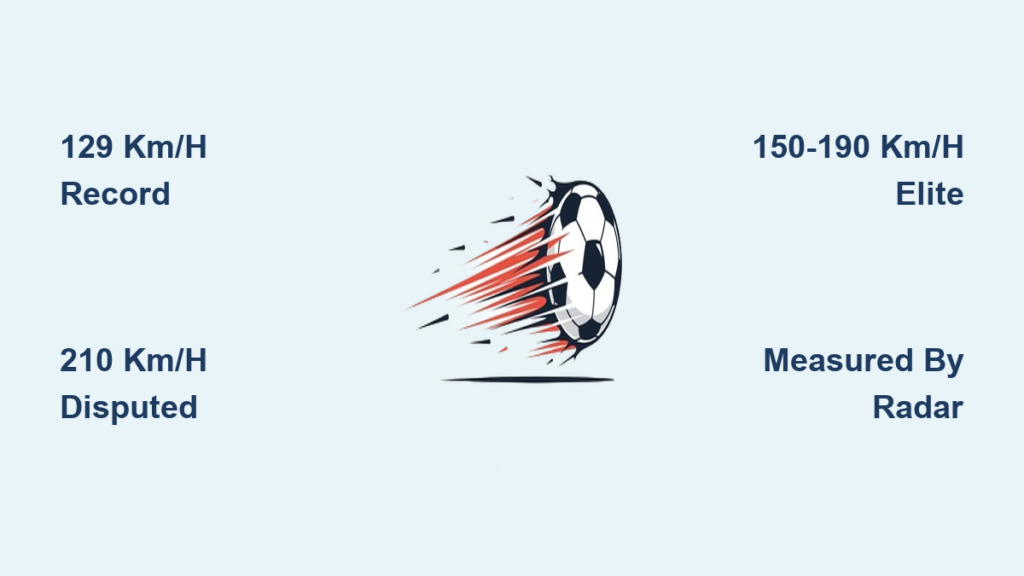
The Guinness World Record for fastest soccer ball kick belongs to Spanish stuntman and football performer Francisco Javier Galan Màrin, who achieved 129 km/h (80.1 mph) in 2001 under official supervision. Using calibrated radar and high-speed tracking equipment in a controlled studio environment, Guinness confirmed this speed while eliminating wind, surface inconsistencies, and measurement error that typically affect in-game readings.
This remains the only scientifically validated maximum speed for a human-launched soccer ball. Despite numerous higher claims from professional matches over the years, none have matched Galan Màrin’s level of verification. The controlled conditions provided the gold standard for accuracy, making this the benchmark against which all other claims should be measured.
Contested Claims: The 210 km/h Mystery

Brazilian midfielder Ronny Heberson is frequently credited with the fastest-ever recorded shot: 210.9 km/h (131.8 mph) during a 2006 Primeira Liga match. Portuguese physicist José Soares measured this speed using radar, and the figure has never been formally retracted. However, experts widely dispute this claim.
Generating such speed would require approximately 1,400 joules of kinetic energy, which far exceeds typical human muscular output. Frame-by-frame video analysis suggests the actual speed was closer to 100 to 120 km/h, raising questions about whether the radar captured peak foot swing speed rather than actual ball exit velocity. Despite the controversy, the claim persists in media and marketing, symbolizing the theoretical upper limit of kicking power.
Elite In-Game Speeds: 150 to 190 km/h
Several elite players have recorded unofficial speeds between 150 and 190 km/h in competitive or friendly matches. Arjen Robben achieved 190 km/h during a 2009 friendly with a left-footed volley. Steven Reid recorded 189 km/h in a 2005 Premier League match, with goalkeeper Brad Friedel famously remaining motionless as the ball struck the net. Ronald Koeman’s 188 km/h free kick secured Barcelona’s 1992 European Cup victory. David Hirst’s 183 km/h half-volley in 1996 was reportedly audible throughout Hillsborough Stadium.
These figures came from stadium radar systems, which are less precise than laboratory equipment but widely accepted within context. They represent the upper tier of in-game striking power, though none carry official verification.
How Soccer Ball Speed Gets Measured
Understanding measurement methods explains why reported speeds vary so dramatically across different sources and time periods.
Radar Guns in Live Broadcasts
Doppler radar guns, similar to those used in baseball and tennis, are deployed in some leagues including the Premier League and MLS. These devices capture shot speed immediately after impact, providing instant readings during live broadcasts. The main drawback is sensitivity to angle and calibration, plus the risk of recording leg swing speed instead of actual ball velocity.
High-Speed Video Analysis
Tracking ball position across frames at 120 to 1000 frames per second allows calculation of flight time and resultant speed using projectile motion equations. For example, a ball traveling 22.7 meters in 1.4 seconds yields a horizontal velocity of approximately 16.7 m/s. When combined with vertical velocity of about 7 m/s, the resultant speed calculates to approximately 17.6 m/s or 63.4 km/h. This method is reliable for research settings but rarely used in professional match analysis.
Smart Balls and Embedded Sensors
Adidas miCoach and similar sensor-equipped balls measure exit velocity, spin rate, and impact force during training sessions. While accurate, these devices are not permitted in official matches, limiting real-world competitive data.
Typical Speeds by Player Level
Ball speed scales dramatically with skill, strength, and intent. Most goals are not about raw power but rather placement. Here is what different levels typically achieve.
• Young amateurs: 60 to 80 km/h during casual play
• Adult amateurs: approximately 79 km/h based on scientific averages
• Professional players: approximately 108 km/h as the average maximum
• Elite power strikers: 150 to 190 km/h during in-game rockets
• Record-tier contested: 210.9 km/h for Ronny Heberson
The majority of goals are scored at 72 to 105 km/h, where accuracy outweighs velocity.
What Determines Soccer Ball Speed

Speed is not just about leg strength. It results from a combination of biomechanics, technique, and equipment working in harmony.
Key Biomechanical Factors
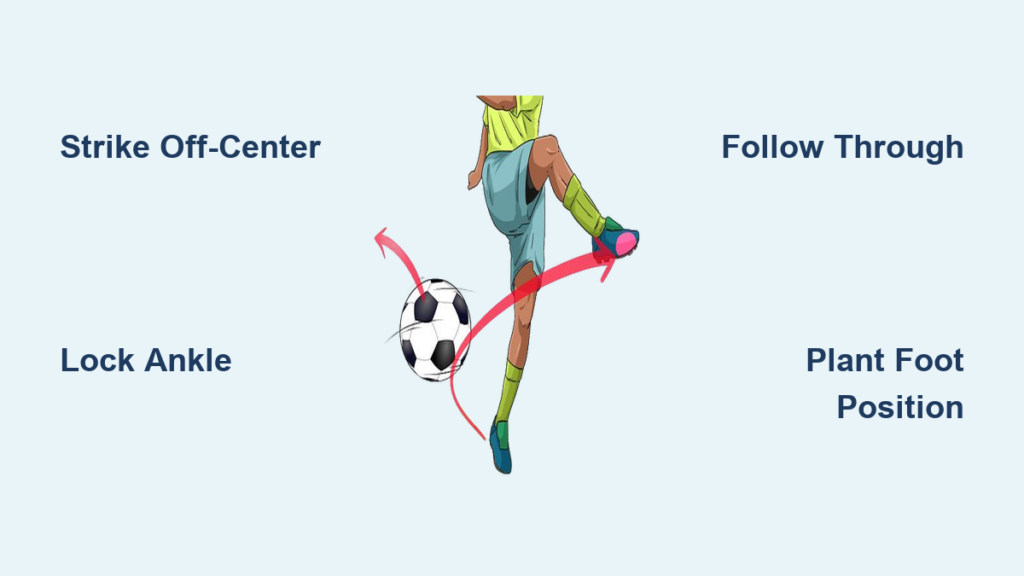
Hip flexion and knee extension generate the primary leg swing speed. Core stability enables efficient force transfer from torso to limb. Neuromuscular timing coordinates muscle activation for peak foot velocity at the exact moment of contact. Ankle locking prevents energy loss during the brief impact window. Elite kickers achieve foot speeds exceeding 20 m/s, which directly correlates with ball exit velocity.
How Kicking Technique Affects Speed
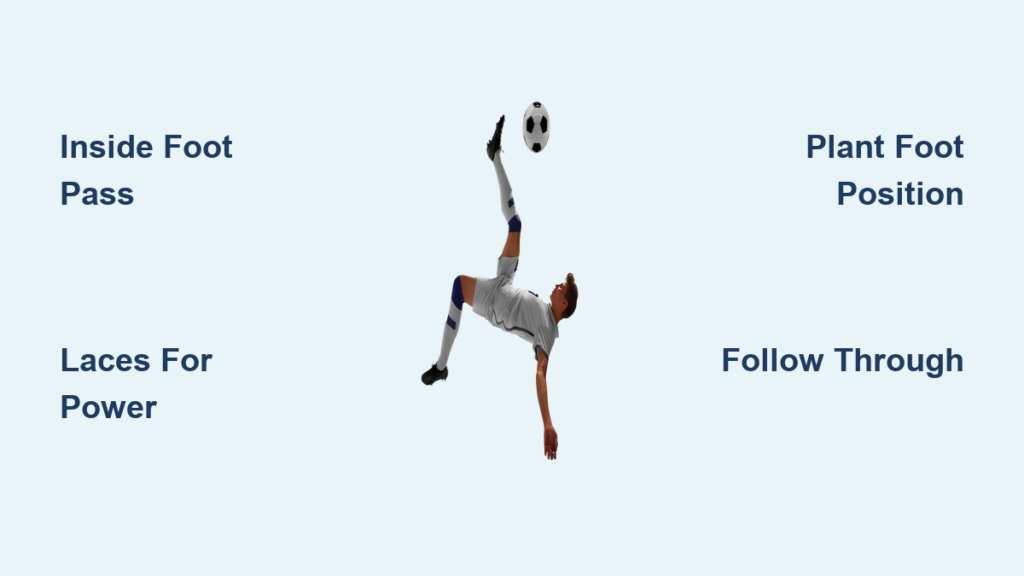
The instep drive, using the laces area, produces the highest speed due to large contact area and full follow-through. This technique works best for powerful shots and long passes when precise contact through the ball’s center is achieved. Volleys generate high speed but with shorter contact time and less control, making them common for acrobatic finishes. The inside-of-the-foot pass prioritizes accuracy over power, averaging 40 to 60 km/h for short combinations. Toe pokes create unstable energy transfer and are rarely used intentionally for speed, appearing mostly in interception attempts.
Environmental and Equipment Influences
Ball inflation matters significantly, as under-inflated balls absorb energy and reduce rebound. Surface type affects energy transfer, with firm turf enhancing performance compared to muddy ground. Wind and altitude play roles, with thinner air at high altitudes reducing drag. Ball design including panel stitching and texture affects aerodynamics. A wet or worn ball can reduce speed by up to 15% due to increased air resistance.
Hard Shot Classification Standards
While no official classification exists, general consensus defines power tiers in professional football.
• Placed shot: below 96 km/h with emphasis on accuracy
• Driven shot: 96 to 112 km/h balancing power and precision
• Hard strike: 120 km/h or higher representing elite-level power
• Exceptional: 136 km/h or higher seen in record attempts
• Record-tier: 180 km/h or higher reserved for top-tier professionals
Terms like “rocket,” “screamer,” and “thunderbolt” appear frequently in commentary, but true record-tier strikes remain rare.
Debunking Common Myths
Several widely circulated speed claims lack verification or contain factual errors. The alleged Eder goal at 167 km/h in 1982 is impossible because Eder was born in 1987 and did not play professionally until the late 2000s. This is likely a typographical error or player confusion. David Hirst’s widely reported 114 mph strike lacks public radar confirmation, and it remains unclear whether speed was measured at impact or mid-flight. Zach Thornton’s 90 mph MLS shot is plausible but not officially documented and may have involved modified equipment.
Due to these inconsistencies, only data supported by video evidence, league records, or reputable scientific sources should be trusted.
Soccer Compared to Other Sports

How does soccer stack up against other athletic pursuits? Tennis serves reach 225 km/h, with John Isner and Novak Djokovic holding records. Baseball pitches peak at 169.1 km/h by Aroldis Chapman. Golf drives exceed 335 km/h off the driver on the PGA Tour. Cricket fast bowls reach 161.3 km/h, with Shoaib Akhtar holding the record.
Despite lower average velocities, soccer’s claimed peak exceeds baseball’s, though this difference likely stems from measurement timing and lack of standardization across sports.
Visual Signs of High-Speed Shots
You can often identify a high-speed strike through several telltale signs. Motion blur makes the ball appear as a streak in video replays. The auditory “crack” at impact creates a sharp pop from rapid air displacement. A flat trajectory with minimal arc appears when the ball is struck cleanly. Goalkeeper reaction typically begins after the ball has already passed, emphasizing the importance of anticipation over reflexes.
Ronny Heberson’s famous free kick is described as “so fast you can barely see it move” in broadcast commentary.
Training and Tactical Applications
Speed is not just spectacle but shapes strategy and player development across all levels.
Goalkeeper reaction training uses simulators replicating shots over 100 km/h, though the focus shifts from pure reflexes to anticipation and positioning. Keepers learn to read striker body language before the kick rather than reacting to the ball itself. Player development programs teach proper striking mechanics to build power safely, with exit velocity becoming a key metric in academies. Motion tracking analyzes swing path, contact point, and follow-through to optimize technique.
Set-piece specialists like Beckham, Messi, and Koeman are studied for their combination of power and precision. Broadcasting integration now displays real-time shot speeds during Premier League and Champions League matches, making speed data accessible to fans and driving engagement.
Future of Speed Measurement
Technology continues to improve accuracy and accessibility of soccer ball speed data. Real-time tracking systems like Hawk-Eye and STATSports now provide shot speed, spin rate, and expected goal data. Machine learning models predict outcomes based on velocity, angle, and defender positioning. Broadcast integration makes speed data accessible to mainstream audiences. Clubs and federations increasingly advocate for universal measurement protocols to resolve discrepancies across competitions.
Future records will likely be more transparent, verifiable, and publicly accessible as technology advances.
Frequently Asked Questions About Soccer Ball Speed
What is the fastest officially recorded soccer ball speed?
The Guinness World Record stands at 129 km/h (80.1 mph), achieved by Francisco Javier Galan Màrin in 2001 under controlled laboratory conditions with calibrated radar equipment.
Has anyone actually kicked a soccer ball at 210 km/h?
The 210.9 km/h claim attributed to Ronny Heberson in 2006 remains contested. Scientists estimate such speed would require 1,400 joules of energy, far beyond typical human output. Video analysis suggests the actual speed was likely 100 to 120 km/h.
How fast do professional soccer players kick?
Professional players average approximately 108 km/h for their maximum shot speed. Elite power strikers can reach 150 to 190 km/h during competitive matches, with names like Arjen Robben, Steven Reid, and Ronald Koeman in this range.
What is considered a hard shot in soccer?
A hard shot typically starts at 120 km/h (75 mph) or higher. Elite-level power strikes exceed this threshold, while anything below 96 km/h generally counts as a placed shot prioritizing accuracy.
How fast is a typical goal-scoring shot?
Most goals are scored at 72 to 105 km/h (45 to 65 mph), where placement and timing outweigh raw velocity. Even at these speeds, goalkeepers have less than half a second to react.
Does soccer ball speed compare to other sports?
Soccer ball speeds can exceed baseball pitches, with the contested record of 210.9 km/h surpassing Aroldis Chapman’s 169.1 km/h fastball. However, tennis serves and golf drives regularly exceed soccer’s maximum speeds.
Key Takeaways for Understanding Soccer Ball Speed
The official verified record stands at 129 km/h (80.1 mph) by Francisco Javier Galan Màrin in controlled conditions. The highest contested claim reaches 210.9 km/h (131.8 mph) by Ronny Heberson, though scientists widely dispute this measurement. Elite in-game speeds typically range from 150 to 190 km/h among professional power strikers, while the average professional maxes out around 108 km/h. Most goals are scored at 72 to 105 km/h, proving that placement consistently trumps raw power.
Speed depends on technique, biomechanics, equipment, and environmental conditions. For players seeking to increase shot power, focus on instep drive mechanics, core strength development, and complete follow-through. For fans, next time you witness a “rocket shot” on television, remember that true power lies not just in speed but in the science and skill behind it.