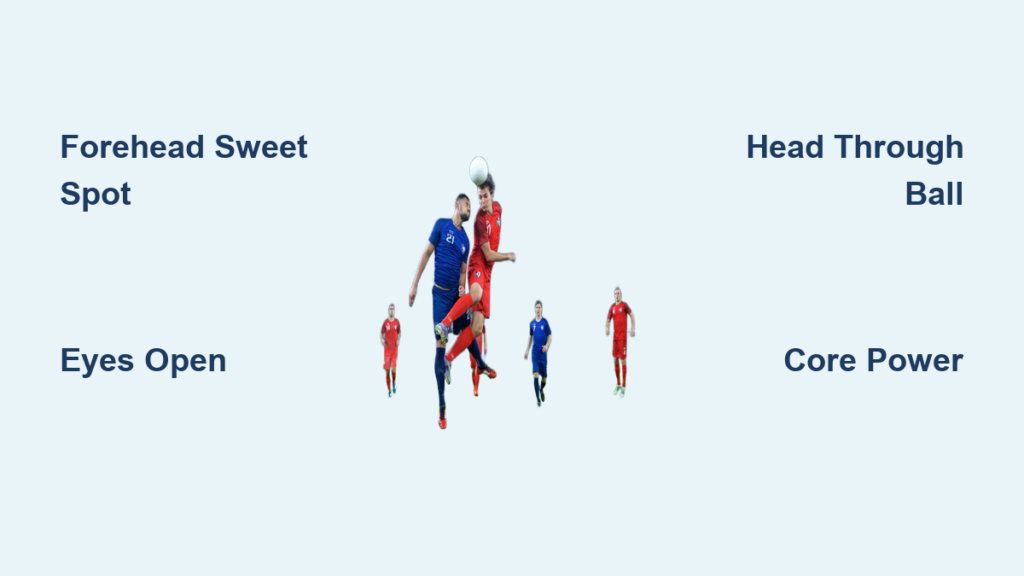
Heading the ball is one of the most powerful skills in soccer. A well-timed header can score goals, win crucial aerial duels, and turn defense into attack in an instant. But many players fear heading the ball because they lack proper technique or have experienced discomfort from incorrect contact. Learning how to head a soccer ball correctly eliminates pain, reduces injury risk, and transforms an intimidating maneuver into a reliable weapon. This guide covers the sweet spot for contact, body positioning, power generation, and proven drills to build your skills safely.
You will discover the exact mechanics used by elite players, common mistakes to avoid, and step-by-step training methods that work for beginners and experienced athletes alike.
Find the Forehead Sweet Spot
Hit the Center, Not the Crown
Always strike the ball with the center of your forehead, just above the eyebrows and near the hairline. This bony area is your natural sweet spot. It transfers force cleanly without causing pain or discomfort.
Avoid using the top of your head, temples, or the back of your skull. These areas are more sensitive and prone to injury. Hitting off-center also reduces control and sends the ball flying unpredictably.
Visualize a small target right between your eyes, above the bridge of your nose. That is where the ball should make flush contact.
Make Full, Flush Contact
Do not glance or tap the ball. Drive through it with solid, centered contact. Think of heading like punching: you want to follow through, not recoil.
A full connection gives you more power and direction. Glancing contact often results in weak, inaccurate headers.
Practice this by starting close to a wall or partner. Ensure every touch lands squarely on the sweet spot before increasing speed or distance.
Keep Eyes Open and Focused
Track the Ball to Impact
One of the most common mistakes is closing your eyes at the last second. This kills timing, accuracy, and confidence.
Instead, watch the ball from the moment it is kicked. Follow its path all the way into your forehead. Use peripheral vision to track defenders and space around you.
Players who keep their eyes open react faster, time jumps better, and place headers with precision even under pressure.
Fix: Train with Slow Tosses
If you flinch or blink, start slow. Have a partner gently toss the ball to your forehead. Focus only on eye discipline. See the ball, feel the contact, stay locked on.
Repeat until the instinct to close your eyes disappears. This builds trust in proper technique and removes fear from the equation.
Use Active, Not Passive, Contact
Do Not Let the Ball Hit You
Never wait for the ball to strike your head. That is passive and dangerous. Instead, move your head forward to meet the ball.
This active engagement increases power and control. It also reduces jarring impact. You are initiating force, not absorbing it. Think of it like throwing a punch rather than getting punched.
Head Through the Ball Mindset
Think: strike, not react. At the point of contact, drive your head slightly forward, following the intended direction. This follow-through ensures clean redirection and prevents bouncing off the ball.
Practice this motion slowly at first. Emphasize propulsion, not recoil.
Set Your Body for Power
Start in an Athletic Stance
Before the ball arrives, be ready. Feet shoulder-width apart. Knees slightly bent. Weight on the balls of your feet.
This stance allows quick movement, balance in mid-air, and explosive takeoff when jumping. Stay light on your feet. Do not lock your knees or stand flat-footed.
Align Shoulders, Hips, and Head
Misalignment causes weak headers and neck strain. At impact, your shoulders, hips, and head should be vertically stacked. Chin slightly tucked. Spine straight, not arched or twisted.
A neutral spine transfers force efficiently and protects your neck from injury.
Avoid Leaning Back
Tilting your head or body backward reduces control and often sends the ball skyward. Instead, maintain a slight forward lean, especially when aiming downward for shots or clearances.
Generate Power from the Core
Snap Your Torso Forward
Most heading power comes from your core, not your neck. To build force, begin with a small backward bend of the torso. As the ball approaches, snap your upper body forward using your abs and obliques. Drive your head into the ball at the peak of this motion.
This wind-up and release motion multiplies power, just like a golf swing or tennis serve.
Add Hip Thrust and Leg Drive
For maximum impact, step toward the ball with one foot. Push off the ground with your legs. Thrust your hips forward as you connect.
Combining lower-body momentum with core rotation creates explosive headers, especially on jumps. Move toward the ball, not just upward.
Master Neck Stability
Brace, Do Not Whip
Forget the whiplash myth. A violent head snap weakens control and increases injury risk. Instead, stiffen your neck muscles just before contact. Keep your head rigid and stable, like a batter bracing for a pitch.
This controlled contraction absorbs impact safely and improves accuracy.
Strengthen Your Neck
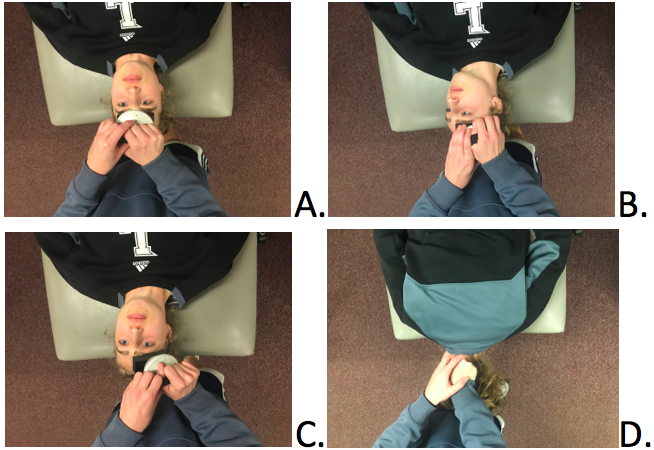
Stronger neck muscles mean better protection. Add these exercises to your training routine.
Isometric holds work well. Press your forehead into your hand from the front, sides, and back. Hold each position for ten to fifteen seconds.
Resistance band pulls also help. Attach a band to a stationary object and pull in all directions.
Controlled curls and extensions are effective too. Lie face-up and gently lift your head off the floor.
Perform two to three sets, two to three times per week. Results improve stability within weeks.
Choose the Right Header for the Situation
Standing Header: Close-Range Control
Use this when the ball is within reach and does not require a jump.
Stand with feet shoulder-width apart. Bend knees slightly. Keep eyes open and head aligned. Move your head forward to meet the ball. Follow through toward your target.
This technique is ideal for quick clearances, short passes, or redirecting crosses.
Jumping Header: Reach the Apex
Use this for crosses, corners, and high balls. Timing is everything. Jump so contact happens at the highest point of your leap. Watch the ball is arc. Do not jump too early or too late.
Boost your height by raising your arms as you jump. Use a short back-step, then explode upward. Time your run from two to three steps out.
Practice judging flight paths. Anticipate the peak of the ball is arc rather than chasing it.
Defensive Header: Clear the Danger
The goal here is to get the ball far and high from your goal.
Position your body toward the sideline, wide of center. Strike the bottom half of the ball. Aim for maximum height and distance.
This prevents giving possession back in dangerous central areas.
Offensive Header: Score or Assist
Two main types work best for scoring.
Driven headers aim low and hard into the corners. Use a compact, powerful motion. Target spaces behind the keeper.
Glancing headers subtly redirect the ball with a slight head turn. Use this to flick behind defenders or across goal. It requires finesse, not force.
Back-post headers are especially effective. Many defenders neglect this zone.
Flick Header: Set Up a Teammate
Use this in buildup play or to redirect aerial balls.
Contact the ball with the top of your forehead. Move your head up and back slightly. Create a soft, upward arc.
This technique is common in back-post plays or when checking in to receive a pass.
Only use this with controlled balls. Never attempt it on high-velocity shots.
Time Your Runs for Game Success
Front-Post vs. Back-Post Strategy
Choose based on cross type and defender position.
Front-post headers work best for low, early crosses. Attack the ball before the defender can react. This often catches the keeper off guard. The risk is potential offside if timed poorly.
Back-post headers offer more space and fewer defenders. They are ideal for flick-ons or finishes. Consistent attackers can score four to five goals per season from this zone.
Let the defender fixate on the ball. Use that split second to slip behind them.
Anticipate the Cross
Read the play before it happens. Watch the passer is body shape. Judge cross height and speed. Start your run one to two seconds before delivery.
The best headers win the first point of contact, not by being tallest, but by being first.
Excel on Corners and Set Pieces
Make a Committed Run
Even if you do not get the ball, a sharp, aggressive run forces defenders to mark you. This opens space for teammates.
Choose front or back post decisively. Explode from a short back-step. Use your arms for balance and lift.
Coaches often say: run like you own the space.
Exploit Keeper Positioning
Watch the goalie. If they drift to one side, aim for the far post. If they stay central, go near post, which is often less defended.
Smart headers beat positioning, not just power.
Train Smart with Proven Drills
Wall Bounce Drill
This builds consistency and contact accuracy.
Stand two to three feet from a wall. Toss the ball gently at forehead height. Head the rebound back to the wall. Focus on sweet spot contact, eyes open, and follow-through.
Increase distance and force as your technique improves.
Partner Toss Drill
This simulates real-game angles.
A partner stands five to ten feet away. They toss the ball underhand to your forehead. Practice standing, jumping, and directional headers.
Add challenge by using side tosses or lobs to train off-center balls.
Heading Circuit Training
Combine footwork and heading for game-ready skills.
Example circuit: ladder drill, then pivot, then receive and head a ball. Or cone weave, then jump header from a cross. Or sprint, then defensive clearance.
This builds reaction, coordination, and game readiness.
Aerial Duel Simulation
Practice one-on-one contests.
Two players compete for a tossed ball. Focus on positioning, timing, and balance.
This teaches physical confidence without reckless contact.
Prevent Injury with Smart Habits
Strengthen Your Neck
As mentioned earlier, stronger necks reduce head acceleration during impact.
Simple routine: isometric holds in all directions, three sets of ten seconds. Resistance band pulls, two sets of twelve reps. Neck curls lying face-up, two sets of ten.
Do this three times per week. Visible gains appear in four to six weeks.
Brace Before Impact
Tense your core and neck slightly just before contact, like bracing for a punch. This stabilizes the spine and absorbs shock more efficiently.
Do not overdo it. Stay relaxed until the last moment, then engage.
Use Protective Gear Wisely
Headgear may reduce impact in player-to-player collisions. It does not prevent concussion from heading. It is not a substitute for technique.
Mouthguards can reduce brain trauma by stabilizing the jaw. They are recommended in contact-heavy environments.
Helmets boost confidence after injury. They are not common but acceptable under FIFA rules.
Follow Safety Rules for Youth Players
Delay Heading Under Age 10
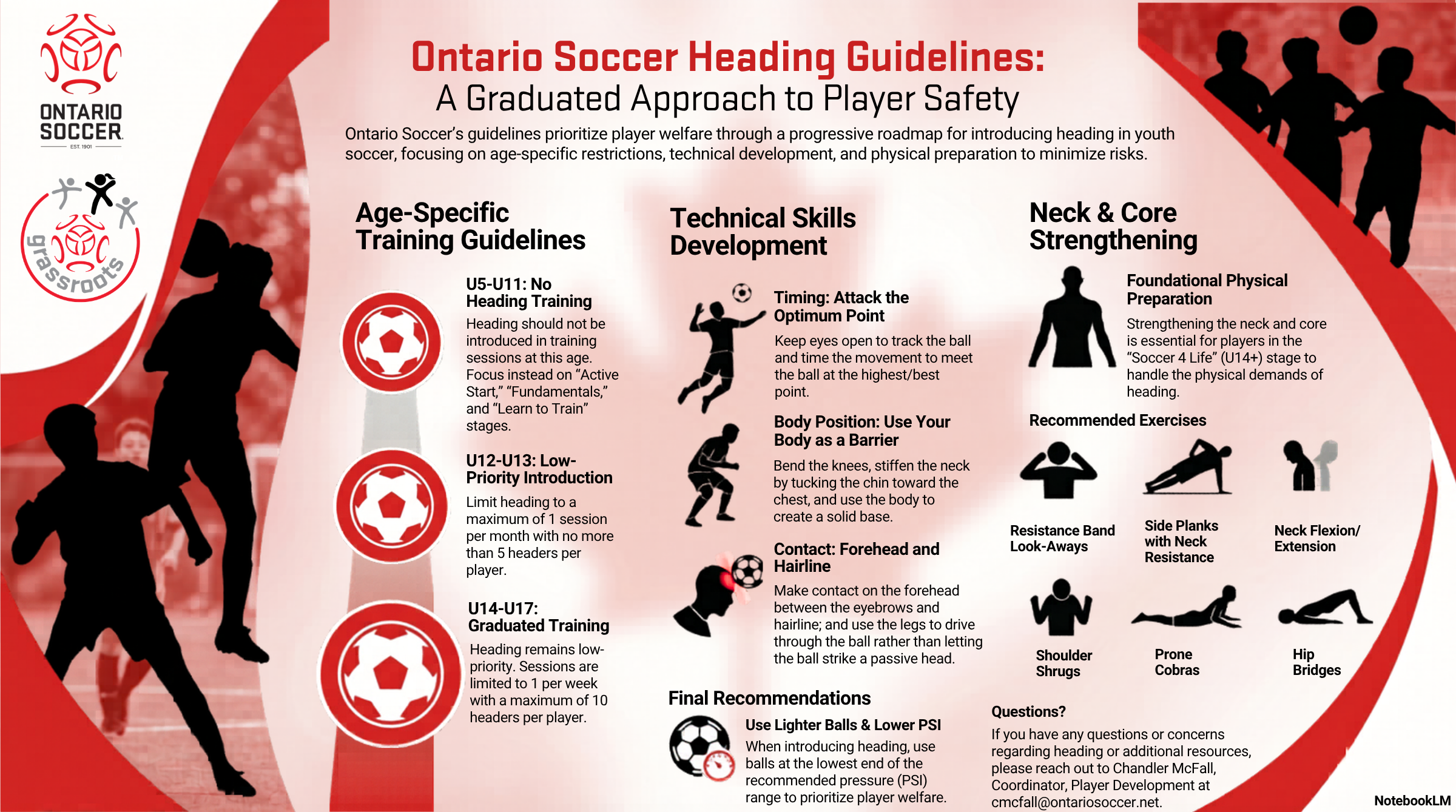
AYSO and U.S. Soccer recommend no heading for players under ten.
Reasons: neck muscles are underdeveloped, poor coordination increases injury risk, and cognitive maturity is still forming.
Focus on technique, footwork, and eye tracking instead.
Use Smaller, Lighter Balls
For U12 and younger, use size three or four balls. Use lower pressure, eight to ten psi instead of twelve to fourteen.
This reduces impact force by up to thirty percent.
Teach Technique First, Frequency Later
When heading begins around U11, limit high-velocity headers in practice. Emphasize form over volume. Use progressive drills: kneeling, then standing, then jumping.
Recognize Concussion Warning Signs
Stop Immediately If You Feel
Headache, dizziness, confusion, blurry vision, or memory loss are red flags for concussion.
Never shake it off. Any suspected head injury requires immediate removal from play, evaluation by a medical professional, and a gradual return-to-play protocol.
Children are especially vulnerable. No same-day return after head trauma.
Build Confidence and Mental Toughness
Overcome Fear with Repetition
Fear comes from lack of control. Fix it by starting slow: soft tosses, close range. Focus on clean contact and eye focus. Gradually increase speed.
Each successful header builds mental strength.
Commit with Aggression
The best headers combine technique and courage. Hesitation loses duels.
Win the first contact. Own the airspace.
Wearing headgear or a mouthguard can boost confidence, but do not rely on gear. Technique wins battles.
Boost Performance Like the Pros
Improve Vertical Jump
Higher leap means earlier contact and competitive edge.
Train with box jumps, three sets of eight. Add squats and lunges to build leg power. Use plyometrics like depth jumps and jump squats.
Pair jump training with heading drills for sport-specific gains.
Anticipate Better
Elite headers read the game early.
Use peripheral vision to track ball and defenders. Study opponent tendencies. Position early, do not react late.
Best headers win before the ball arrives.
Learn from Elite Players
Abby Wambach, one of the most prolific headers in history, attributes success to consistency, not power.
Her keys: eyes on the ball until impact, strike through the ball, break down technique into repeatable steps, practice perfect reps not reckless volume.
Fix Common Mistakes Fast
Eyes Closed at Contact
Risk: poor timing, weak headers. Fix: slow partner tosses, focus only on keeping eyes open.
Head Tilted Backward
Risk: neck strain, sky-high headers. Fix: practice in front of a mirror, check alignment.
Using Neck Instead of Forehead
Risk: pain, loss of control. Fix: wall drills, feel the correct contact point.
Passive Contact
Risk: low power, high injury risk. Fix: drill heading through the ball with active propulsion.
Jumping Too Early or Late
Risk: missed ball, poor positioning. Fix: watch flight path, time jump to meet ball at peak.
Frequently Asked Questions About How to Head a Soccer Ball
What part of the head should you use to head a soccer ball?
Use the center of your forehead, just above the eyebrows and near the hairline. This bony area is your sweet spot. It provides the strongest structural support for clean force transfer and reduces injury risk.
How do I stop being scared to head the ball?
Start with slow, controlled tosses from a close distance. Focus on keeping your eyes open and making flush contact with your forehead sweet spot. Gradually increase speed as your confidence builds. Proper technique eliminates most discomfort and fear.
Is heading bad for your brain?
Current research shows no conclusive evidence that proper heading causes long-term cognitive decline in adult players. Most soccer-related concussions come from player-to-player collisions, not from heading the ball. However, repeated sub-concussive impacts are still studied for potential long-term effects.
At what age should kids start heading the ball?
U.S. Soccer and AYSO recommend delaying heading until age ten or older. Younger children lack neck strength, coordination, and cognitive maturity for safe heading. Use smaller, lighter balls for U12 and younger players.
How can I heading a soccer ball harder?
Generate power from your core and torso, not your neck. Snap your upper body forward while thrusting your hips and driving your legs. Move toward the ball rather than staying static. Practice with progressive distance and speed.
Key Takeaways for How to Head a Soccer Ball
Mastering the header transforms your game. Use the center of your forehead for safe, powerful contact. Keep your eyes locked on the ball from start to finish. Generate force through core rotation and forward momentum, not neck strength.
Practice proper technique through wall drills, partner tosses, and circuit training. Build neck strength to protect yourself from impact. For youth players, delay heading until physical maturity and use age-appropriate balls.
Whether clearing dangerous crosses or scoring from corner kicks, the right technique makes all the difference. Commit to consistent practice, prioritize safety, and watch your aerial game reach new heights.