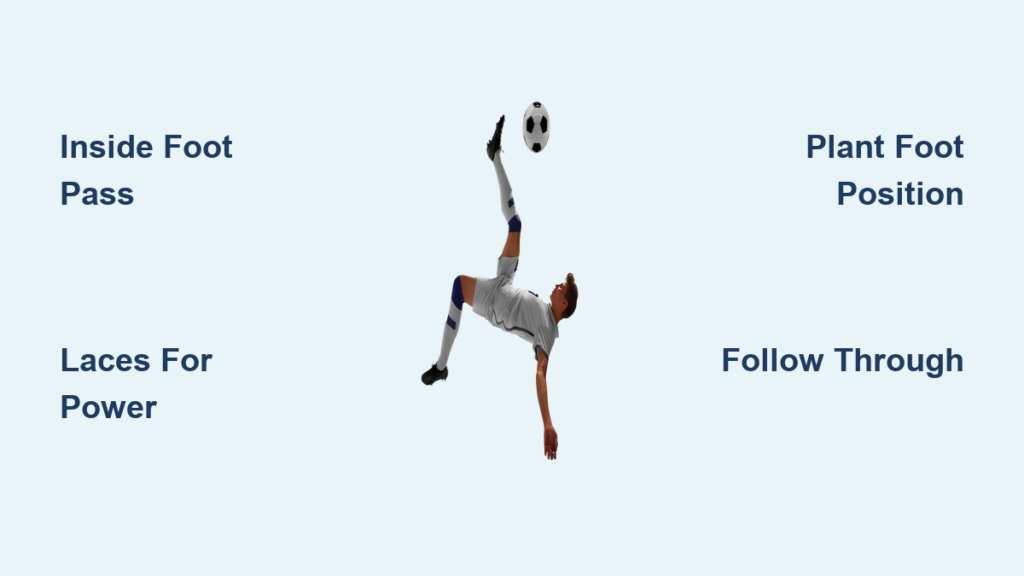
Learning how to kick a soccer ball for beginners starts with mastering the fundamentals: balance, foot placement, and clean contact. It is not about power. It is about precision, repetition, and proper technique. Whether you are passing across the field or taking a shot on goal, every kick relies on the same core mechanics. This guide breaks down exactly how to kick a soccer ball correctly, avoid common mistakes, and build confidence through targeted drills.
You will learn the three essential kicks, how to use the right part of your foot, and what your body should do before, during, and after contact. By the end, you will have a clear, step-by-step blueprint to improve every time you strike the ball.
Master the Three Core Kicks
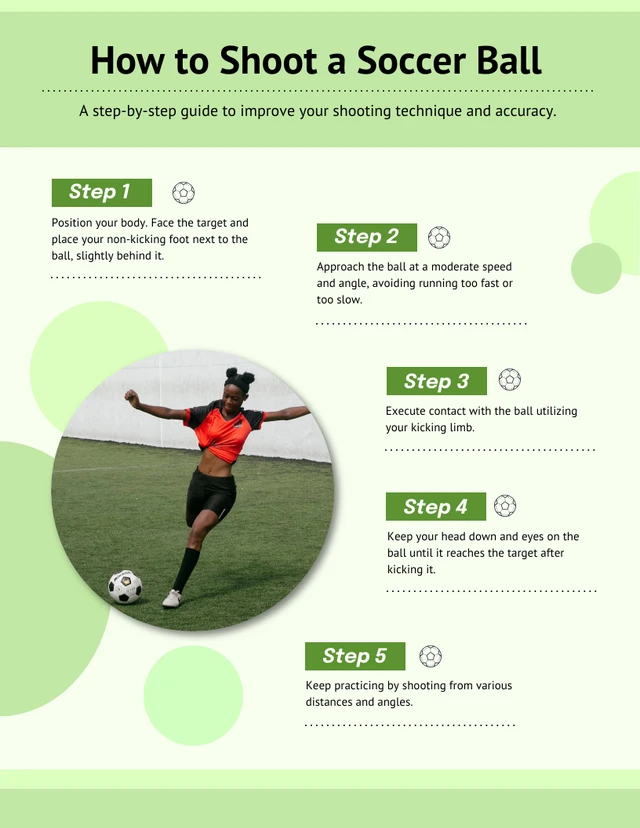
Every beginner must learn three foundational kicks: the ground pass, chip shot, and goal shot. Each uses slightly different mechanics but shares the same kicking principles. Start with these to build a complete skill set for passing, shooting, and game awareness.
Ground Pass: Control and Accuracy
The ground pass is your go-to for short, precise communication between teammates. It keeps the ball low and rolling, making it easy to receive under pressure.
Use the inside of your foot, which is the flat surface that gives you maximum control. Strike the center of the ball to keep it on the ground. This kick works best for distances between 5 and 20 yards. It is ideal for buildup play, tight spaces, and quick transitions.
Pro Tip: Rotate your kicking foot outward like a penguin foot to expose the full inside surface. Point your plant foot toward the target to guide direction.
Chip Shot: Lift the Ball Over Defenders
Use the chip shot when you need to float the ball over a defender or goalkeeper. It is a soft, high-arcing kick that lands gently for a teammate or sneaks into the net.
Contact the bottom third of the ball with your inside or instep, keeping your toes pointed upward. Use a short, scooping swing motion rather than over-swinging. Follow through upward to generate lift.
Avoid hitting the top half of the ball, which drives it into the ground. Keep your eyes down and lean slightly forward to control trajectory.
Goal Shot: Power and Precision
When you are near the goal, the power shot is your finisher. It is fast, direct, and uses your laces to drive the ball low and hard.
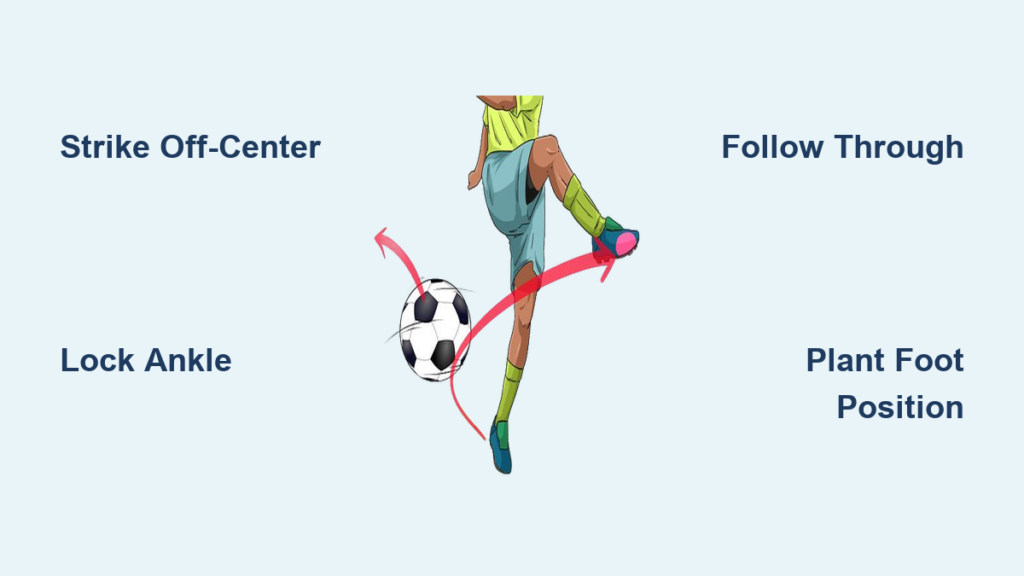
Use the laces, which is the top of your foot, for maximum force. Strike the lower third of the ball to keep it low and powerful. Lock your ankle, point your toes down, and follow through fully. Rotate your hips toward the target to add power.
Key Insight: Power comes from technique, not muscle. A full backswing, hip rotation, and strong follow-through generate more speed than brute strength.
Perfect Your Kicking Technique
A consistent kicking motion makes every type of kick more reliable. Follow this universal framework to build muscle memory and eliminate errors.
Focus on the Ball
Keep your eyes locked on the ball from start to finish. Lifting your head too early throws off your timing and balance.
Pick a specific contact point on the ball, such as the center for passes or the bottom for chips. Stare at that point until after your foot makes contact. Do not glance up early because your body follows your eyes.
Why it matters: Visual focus improves coordination and ensures clean contact. It is the first step to accuracy.
Approach at an Angle
Use a three to five step run-up at a 30 to 45 degree angle to the ball. A straight-on approach limits hip rotation and reduces power.
An angled run-up allows full hip and shoulder turn. Your steps should be light and controlled, not rushed. For short passes, a shorter, straighter approach is acceptable.
Mistake to avoid: Running straight toward the ball pulls your shot across your body. Angle in to open your hips.
Place the Plant Foot Correctly
Your non-kicking foot, called the plant foot, determines accuracy and balance. Get this wrong and your kick goes off target.
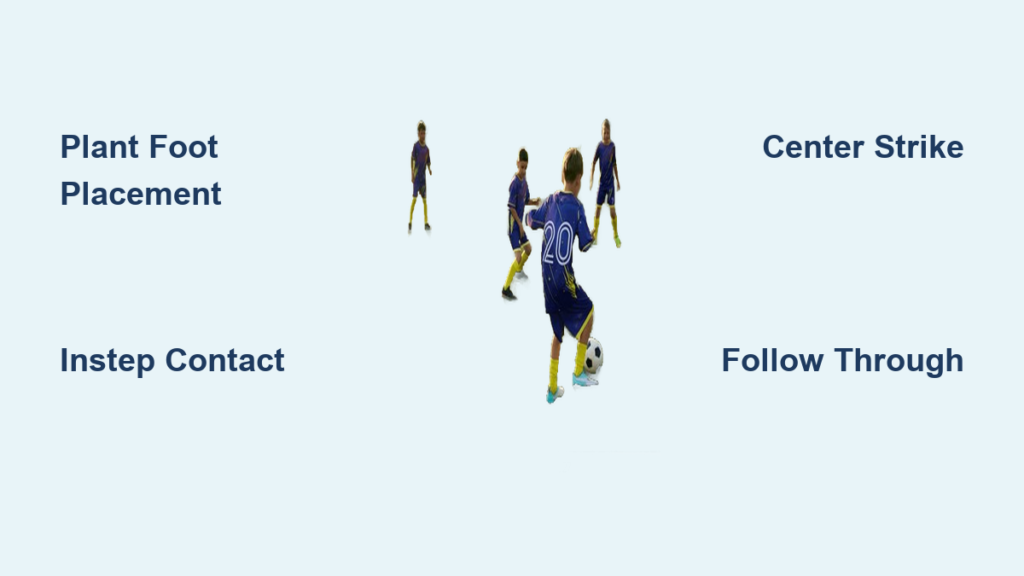
Position the plant foot 5 to 10 inches beside the ball. Point the plant foot toward the target. Do not place it in front or behind the ball, as this changes the ball height.
Right-footed players use the left foot as the plant foot. Left-footed players use the right foot as the plant foot.
Pro Tip: Use a cone or chalk mark to practice consistent placement. A misaligned plant foot results in a misfired kick.
Lean Forward, Not Back
Your body position at impact controls the ball is flight.
Lean slightly forward with your torso over the ball. Keep your head steady and eyes down. Engage your core to stabilize your upper body.
Leaning back causes the ball to fly high. Leaning forward keeps shots low and passes rolling.
Lock Your Ankle and Point Toes
A floppy ankle kills power and can cause injury. You need a rigid striking surface.
Point your toes down before contact for laces shots. Lock your ankle, imagining it is frozen in place. For inside-foot passes, rotate your foot outward to create a flat platform.
Never kick with your big toe. It hurts and ruins control.
Strike the Right Part of the Ball
Where you hit the ball changes its path. Use this guide:
Center contact produces a low, rolling pass and works best for ground passes. Lower third contact creates a driven, powerful shot ideal for goal shots. Bottom contact produces a high arc with soft landing, perfect for chip shots. Top half contact makes the ball dive into the ground and is a common error.
Rule of thumb: Hitting too high makes the ball fly up. Hitting too low makes the ball hit the ground.
Follow Through to the Target
Do not stop at contact. Your follow-through guides direction and adds power.
Extend your leg fully toward the target. Finish with your foot pointing where you want the ball to go. Your body moves forward into the play.
A short follow-through creates a weak, inaccurate kick. A full follow-through produces a strong, on-target strike.
Fix Common Kicking Mistakes
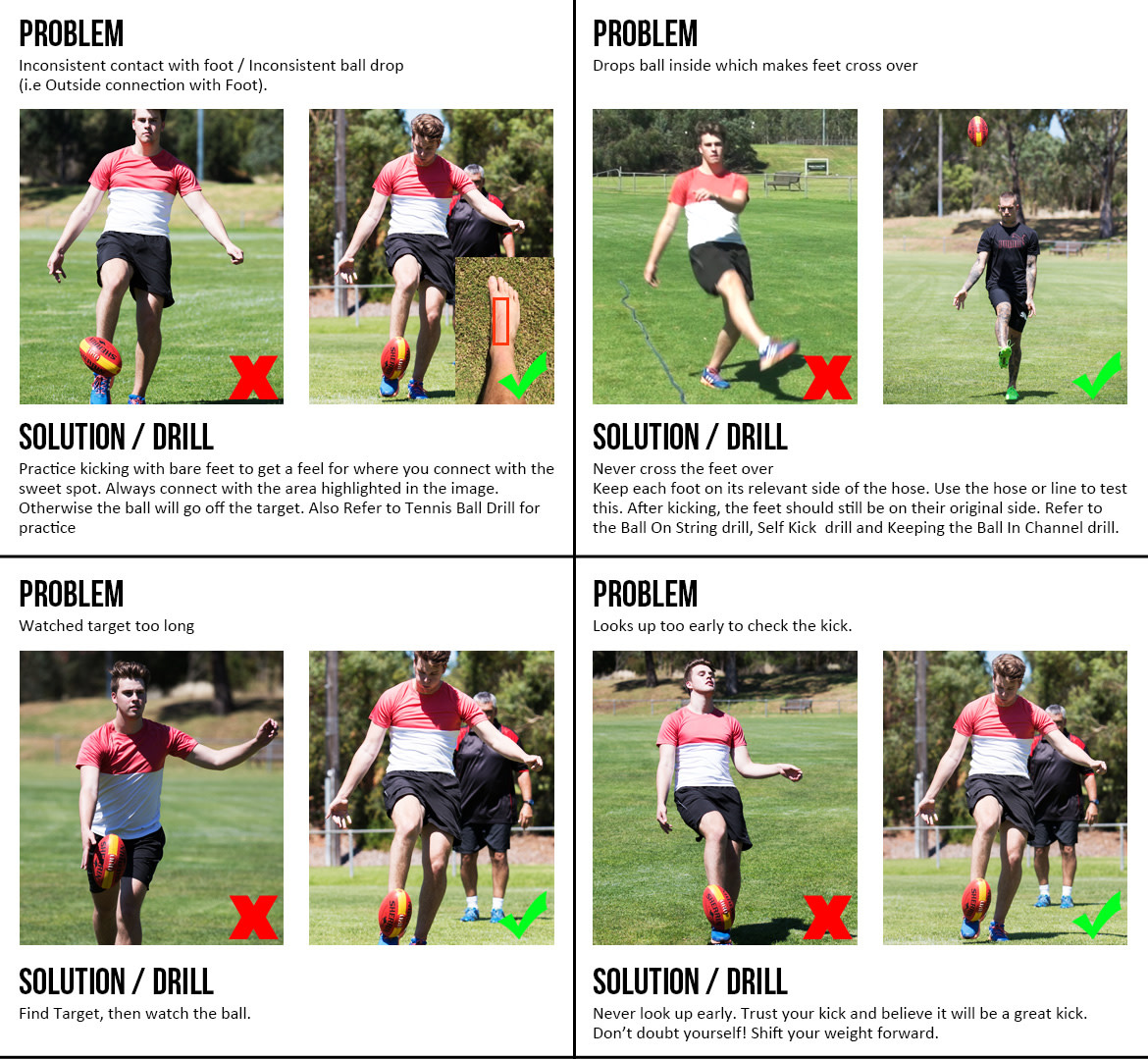
Even beginners can avoid the most frequent errors with simple corrections.
No Backswing? Add One
A long backswing builds momentum. Without it, your kick lacks power.
Swing your kicking leg back before the forward motion. Practice with a cone behind your foot and try to knock it over.
Result: A smoother, more powerful swing.
Straight-On Approach? Switch to Angle
A straight run-up restricts hip rotation and pulls your shot across.
Approach at 30 to 45 degrees. Let your hips open naturally during the kick.
Benefit: More power and better accuracy.
Leaning Back? Shift Forward
If your ball keeps flying high, you are leaning back.
Tilt your upper body slightly forward. Keep your head over the ball at impact.
Visual cue: Imagine you are about to head the ball and stay over it.
Kicking with Big Toe? Use Instep
Hitting the ball with your big toe is painful and inaccurate.
Use your laces or inside of your foot. Point your toes down and lock your ankle.
Drill: Practice shadow kicks to reinforce correct foot position.
Stopping at Impact? Complete Follow-Through
Cutting your motion short kills accuracy and power.
Swing through the ball, do not swing at it. Finish with your arms balanced and your body moving forward.
Think: Kick and keep going.
Build Accuracy and Power
Accuracy and power are not opposites. They come from the same technique.
Accuracy: Align and Aim
Precision starts before you kick.
Point your plant foot at your target. Square your hips to the goal or receiver. Follow through in the direction of your aim.
Training tip: Use cones or goal quadrants as targets. Aim for the same spot 10 times in a row.
Power: Use the Kinetic Chain
Power flows from your hips to your foot in a sequence.
Hips rotate first, then the thigh, then the knee, then the shin, then the ankle, then the foot, and finally the ball.
A long backswing creates more momentum. Full hip rotation produces more force. An arm swing provides balance and extra power when the opposite arm swings forward.
Remember: Technique beats strength. A well-executed kick with proper form travels farther than a wild swing.
Train Your Weak Foot
Being one-footed limits your options. Start training your weak foot now.
Use Same Mechanics
Apply identical form to both feet.
Use the same plant foot distance. Maintain the same body position. Complete the same follow-through.
Start slow and focus on control, not power.
Practice Drills
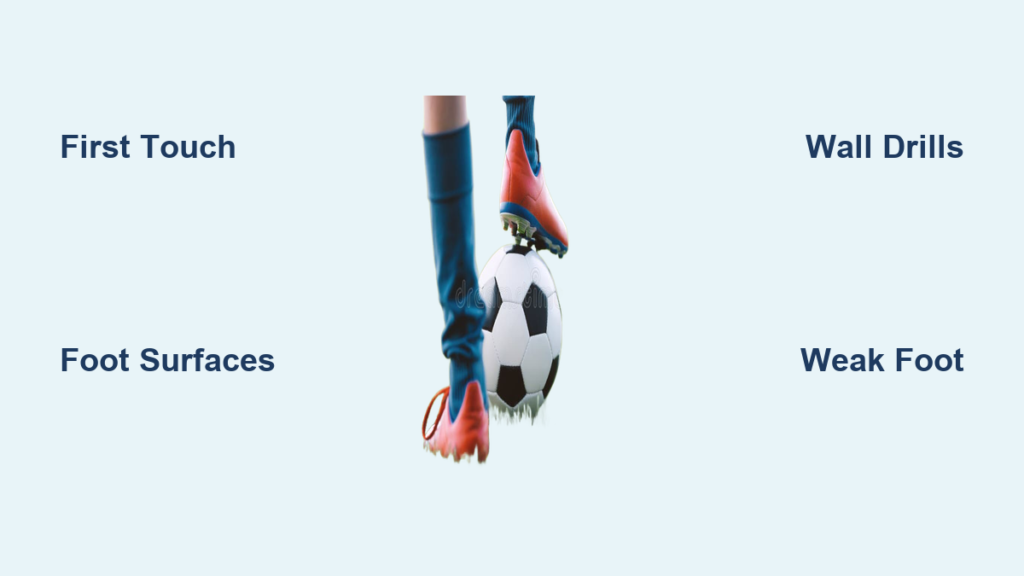
Wall passes: Kick 50 times with your weak foot daily. Two-touch drill: Control with your weak foot and shoot with your strong foot. Set goals such as hitting the target 6 out of 10 times.
Goal: Achieve 60 percent effectiveness with your weak foot within 8 weeks.
Master the First Touch
A bad first touch ruins a good opportunity. Learn to control the ball before you kick.
Cushion the Ball
Meet the ball in front of your body. Drag your foot back slightly to absorb the speed. Keep the ball close and do not let it bounce away.
Drill: Roll a ball toward yourself, stop it, and then shoot in one motion.
Why it matters: A soft first touch sets up clean, confident kicks.
Practice Alone with These Drills
No partner? No problem. These solo methods build real skills.
Wall Practice: Build Repetition
Stand 6 to 10 feet from a wall. Kick the ball against it, retrieve it, and repeat. Start with two-touch: control first, then kick. Progress to one-touch and shoot immediately.
Add targets by taping squares on the wall to improve aim.
Benefit: Hundreds of reps in one session, perfect for muscle memory.
Shadow Kicking: Perfect Form
Practice without a ball.
Go through the full motion: approach, plant, swing, and follow through. Use a mirror to check your posture and alignment. Focus on ankle lock, hip rotation, and follow-through.
Best for: Warm-up or correcting technique.
Develop Key Physical Skills
Kicking well is not just technical. It is physical.
Strengthen Ankles
Do resistance band exercises. Practice balance drills like single-leg stands.
Purpose: Lock your foot securely at impact.
Improve Hip Flexibility
Do dynamic stretches before practice. Include leg swings, lunges, and hip circles.
Benefit: Full range of motion for powerful swings.
Build Core Stability
Do planks, Russian twists, and bird-dogs.
Why: A strong core keeps your torso steady during kicks.
Enhance Balance and Coordination
Practice single-leg passes. Jump and land on your plant foot before kicking.
Result: Better control in motion.
Track Your Progress with Goals
Set clear benchmarks to measure improvement.
Skill: Accuracy. Beginner Goal: Hit target 7 out of 10 times from 15 yards.
Skill: Power. Beginner Goal: Drive ball 20 to 30 yards with proper technique.
Skill: Consistency. Beginner Goal: Correct form in 80 percent of attempts.
Skill: Weak Foot. Beginner Goal: 60 percent effectiveness in 8 weeks.
Skill: One-Touch. Beginner Goal: Clean contact on 6 of 10 attempts.
Tip: Record yourself weekly to spot improvements in plant foot, follow-through, and posture.
Frequently Asked Questions About Kicking a Soccer Ball
What is the easiest kick to learn first?
The ground pass using the inside of your foot is the easiest kick to learn first. It provides the largest striking surface for maximum control and keeps the ball low and rolling. Master this before moving to chip shots and power shots.
Which part of the foot should I use to kick a soccer ball?
Use the inside of your foot for passes and ground shots. Use the laces, which is the top of your foot, for power shots. Use the instep for chip shots. Avoid kicking with your big toe because it causes pain and loses control.
How can I kick a soccer ball harder without using more muscle?
Power comes from technique, not muscle strength. Use a full backswing, rotate your hips fully, lock your ankle, and complete a strong follow-through. The kinetic chain from hips to foot generates more force than brute strength alone.
Why does my kick always go over the goal?
Kicking the ball too high usually means you are leaning backward or striking the top half of the ball. Fix this by leaning forward over the ball at impact and aiming for the lower third of the ball with your laces.
How long does it take to learn how to kick a soccer ball properly?
With consistent practice of 50 to 100 kicks per session, most beginners see significant improvement within 4 to 6 weeks. Mastering proper form takes 2 to 3 months of dedicated practice. Muscle memory develops through repetition over time.
Should I practice kicking with both feet?
Yes, training your weak foot is essential. Use the same mechanics for both feet and practice at least 50 weak-foot kicks per week. Aim for 60 percent effectiveness compared to your strong foot within 8 weeks.
Start Practicing Today
You now know how to kick a soccer ball for beginners step by step. Focus on the fundamentals: eyes on the ball, angled approach, correct foot placement, and full follow-through. Practice the ground pass, chip shot, and goal shot with intention. Fix common mistakes before they become habits. Train your weak foot and master your first touch. Use wall and shadow drills to build repetition. Track your progress with clear goals.
Final Advice: Practice 50 to 100 kicks per session. Start slow and prioritize form. Be patient because muscle memory takes time. Join a game or team to apply skills under pressure.
The only way to get better is to kick the ball again and again. Now go out and do it.